
MUSEO de ANTIOQUIA (Museum of ANTIOQUIA)
Carrera 52 # 52-43, Medellín, Antioquia, Colombia
Tel. +57 (4) 251 3636
http://www.museodeantioquia.co/
email: archivo.historico@medellin.gov.co
We work with and recommend booking flights with www.kiwi.com
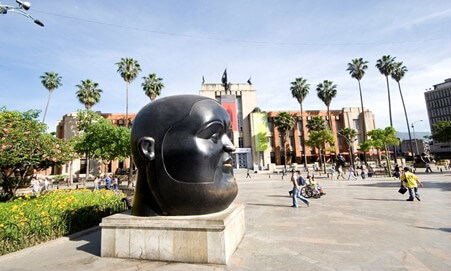
Located in the downtown area of El Centro, Museo de Antioquia is a grand building that overlooks the busy Plaza Botero. Home to a wide range of exhibitions, the museum offers a unique insight into the department of Antioquia and Medellín’s role in its story.
Whether you are an art-lover, a history buff or simply want to pass time, a trip to Museo de Antioquia is a great activity.
The Museo de Antioquia has a fascinating history that dates back to its inception in November 1881. Its early years faced challenges, including crises, closures, and re-openings under the name Zea Museum.
They named it after botanist and diplomat Francisco Antonio Zea, who played a key role in the early 19th-century independence struggles.
During its early years, the museum earned recognition as the first to open in Antioquia and the second in Colombia. The institution flourished thanks to the generous support of renowned artist Fernando Botero, becoming an iconic art center in Medellín.
Even if you’re not familiar with Fernando Botero, you’ve likely seen his work around the world. Exhibits have appeared on Park Avenue in New York City, the Champs-Élysées in Paris, and other famous cities. In Colombia, Botero is certainly the most prolific painter and sculptor ever known.
He was born in Medellín in 1932 and initially went to matador school to learn to become a bullfighter. After changing his mind, he pursued the arts, studying famous works in Madrid, Paris, and Florence.
Fernando Botero played a key role in the museum’s growth by donating his artworks and providing financial and artistic support. In 1975 the institution received the painting El Exvoto from the maestro himself.
This bequest created a close relationship, prompting Botero to contribute again in 1975, 1984, and the late 1990s.
In 2000, under Botero’s guidance, the museum moved to the historic Municipal Palace and became Museo de Antioquia. It opened on October 15, 2000, and they inaugurated the art statues in Plaza Botero a year later.
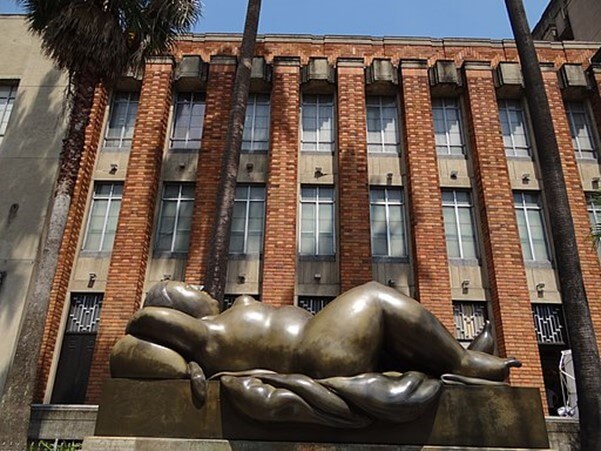
Before entering into the museum, it is well worthwhile to take a few moments wandering among the bronze Botero statues scattered around Plaza Botero. The sculptures, combined with the looming Gothic design of Rafael Uribe Palace of Culture, make for a perfect photo opportunity.
The 14,500 m²/156,077 sq. ft building, with influences of American Art Deco, has eleven fresco murals by the artist Pedro Nel Gómez. Some of these had to be installed by crane given their size and weight. The building itself alone is worth visiting. Designed by H. M. Rodríguez and Sons, its magnificent spaces reflect the splendour and grandeur of Medellín nearly a century ago, when it was graduating from being a large town and becoming the city that it is today.
The building was declared an Architectural Heritage of the Nation and fully restored in the nineties by the Ferrocarril de Antioquia Foundation.
Since 2010, the Museum, in partnership with the Mayor’s Office of Medellín, has promoted a plan for urban renewal and the construction of the cultural projects in centro – the city centre. Through programs and projects such as Museo 360, this positively impacts the dynamics of the area and the development of the people who make up its immediate environment.
Within the museum’s walls visitors can explore a diverse array of art forms, including drawings, paintings, sculptures and objects of historical significance.
The Museo de Antioquia proudly houses permanent works by several local artists, among them Debora Arango and Pedro Nel Gomez, whose contributions illuminate the regional artistic landscape. Throughout its galleries, more than five thousand pieces are exhibited, distributed in temporary and itinerant exhibitions of national and foreign artists.
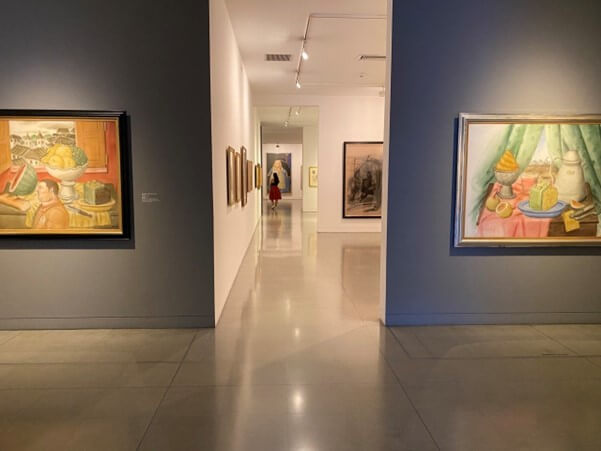
However, the museum’s crowning jewel is the extensive collection of over one hundred eighty eight artistic pieces by Fernando Botero, making it the largest repository of his works in the world. Since Botero first donated to Museo de Antioquia, he has over time donated much of his artwork to Medellín for free.
He is thus widely respected and praised by Paisas (people from Antioquia) for his love and dedication to the city.
We work with and recommend booking flights with www.kiwi.com
Artwork by Botero is best known for featuring plump, rotund people, animals and inert objects. The artist did not consider his subjects fat as such, but rather as a way of exploration of proportion, volume and form. His works are easily identifiable for their distinctive and playful style, yet still exploring important themes.
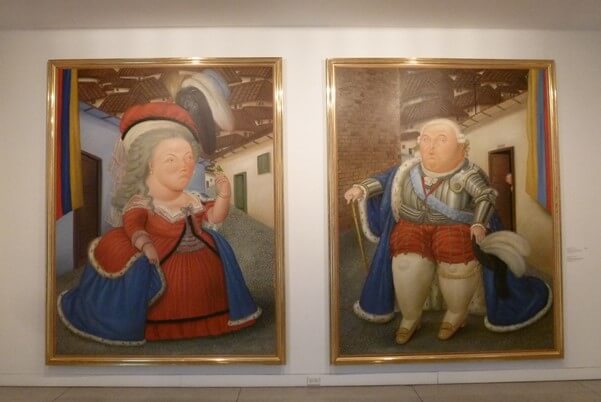
Botero’s subjects range from still life to local characters and cityscapes, many in Antioquia, to bullfighting and the culture surrounding it. The increase in violence during the era of Pablo Escobar is portrayed through his signature style of Boterismo.
Take your time here to relish his unique style ,which has become so famous as it is not possible to take photos in the Botero rooms.
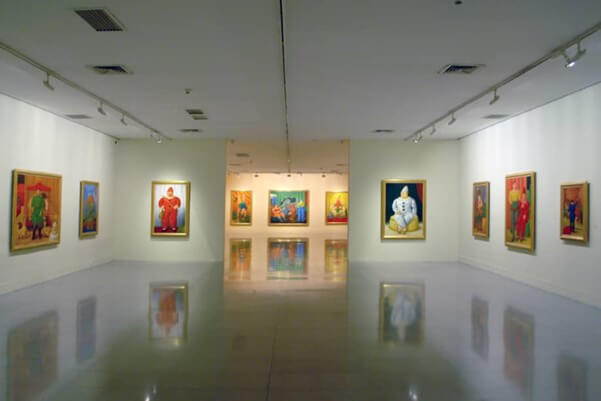
The Museo de Antioquia, the most important museum in Medellín, is not only about Fernando Botero. The quality of all its collections, which come from many world-class artists, is outstanding.
In its halls are naturally enough adorned with works by the Maestro – as previously stated, who was born in 1932 in Medellín – it is also possible to find many others from Rodin to Picasso, passing through the avant-garde work of Éthel Gilmour or the costumbrismo of Cano and Eladio Vélez.
Once inside, the primary exhibit of the museum is the comprehensive collection of Fernando Botero’s paintings and sculptures, located on the third floor. The museum recommends starting here with Botero’s art and slowly working your way down.
There are tours that take place daily at 2 pm for free in Spanish, which give very detailed information. English-speaking tours are available, but they need to be booked in advance with a small fee based on the size of the group.
The museum consists of two wings on three floors hosting a wide range of art and historical artifacts. The museum’s permanent collection is displayed across numerous interconnected rooms:
- Pre-Columbian
- Colonial
- Manuel Angel Uribe room, commemorating one of the founders of the museum
- 19th century painting
- Photographs
- Colombian art
- Francisco Antonio Cano
- Sculpture
- Antioquian artists of the 20th century
- Pedro Nel Gómez
- Contemporary art
- Colombian art of the 20th century
- International art donated by Fernando Botero
- Pedritio Botero room
- Botero donation from 2000
The exhibitions do change on a rotational basis, so it is a good idea to check the museum website beforehand to see what is on display for your visit.
The museum is also home to a library of documents, flags and weapons from the era of Colombian independence. For the Pre-Columbian era, the museum also showcases artifacts, rocks, minerals, coins and other items from that time.
Library of Documents and Films
Talking about history, the museum has volumes of books and documents highlighting history, culture, art and science. It also houses a vast collection of the first publications of newspapers and books in Colombia, brimming with information and the recorded history of the time by the print media.
Also, there are films and other library resources on the history of Medellín and Colombia. It is possible to join workshops in the museum through the School of Arts.
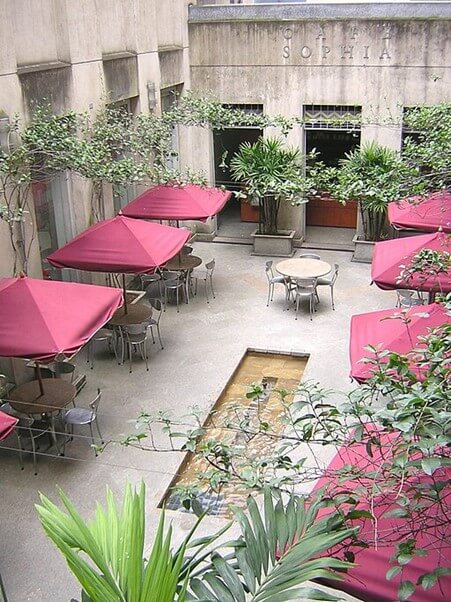
While in the Museo de Antioquia, there is a picturesque courtyard with a fountain to sit outside to enjoy the fresh air. There is a charming café with excellent coffee and a good range of pastries and sandwiches. A restaurant on the first floor has a more substantial offering and worthy of a visit. Additionally, the museum gift shop sells unusual, locally produced items and replicas of artwork from the museum. These make for fantastic gifts for friends and family back home.
Take the first step in planning your dream Colombian vacation by using our Plan My Trip page now!
Museo de Antioquia is available for MICE conventions and other social events. There are delightful spaces for cocktail evenings, meetings, parties and other events. In addition, there are guided tours of the art exhibitions and a full catering service for up to 160 people.
Sala de Consejo/Council Room
The largest room, which is often used by the City Council of Medellín for meetings. There is also seating in the balconies, making it very adaptable for different kinds of events. The mural covering an entire wall is an important Antioquian work of art by Pedro Nel Gómez. Capacity in auditorium layout is 140 – 160 guests.
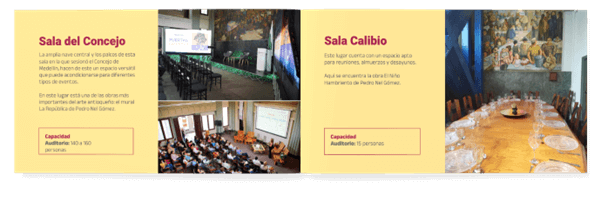 Sala Calibio/Calibio Room
This delightful room has a space suitable for small meetings, breakfasts and lunches. The mural here is again by Pedro Nel Gómez, named The Hungry Child.
Capacity in various layouts is 15 attendees.
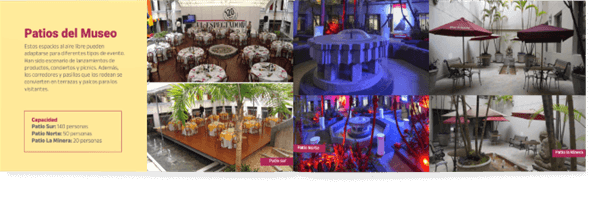 Patios del Museo/Museum Courtyards
These open air spaces are very adaptable to cater for varying events.
They are ideal for product launches, concerts and buffets.
Capacities:
South Courtyard 140 guests
North Courtyard 50 invitees
La Minera Courtyard 20 attendees
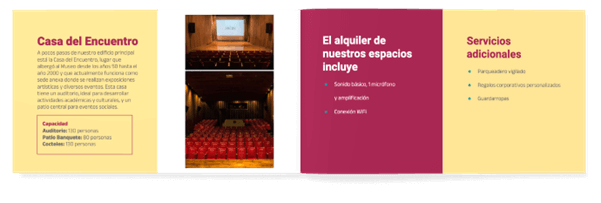
Casa del Encuentro/Meeting Room
Just outside the museum building is La Casa del Encuentro/Meeting Room. Here was housed the Museum from the 1950s until the year 2000. Today it is used as an annex for art exhibitions and other events.
There is an auditorium large enough for a great variety of events, with a central patio area.
Capacities:
Auditorium: 130 people
Banquet Patio: 80 guests
Cocktail: 130 invitees
Without a doubt, the Museo de Antioquia is a must-visit and one of the priority things to see while in Medellín. This is the best of all the museums in the city and is one that reflects the lifestyle, history and culture of the place and its people.
But beyond that, it is also home to the beautiful and impressive collection of art from Colombia’s most important artists such as Fernando Botero and Pedro Nel Goméz, along with a handful of others.
The Museo de Antioquia is also a testament to Medellín’s dramatic change over the years, that has been defined by this transformation.
Like to create or customize a fantastico package tour of Colombia? Use our Plan My Trip page to start planning your dream Colombian vacation now!