
HISTORY OF SALSA DANCE IN COLOMBIA
When night falls over the Colombian city of Cali, the megalopolis lights up with salsa, a palpable electric current that animates and unifies this twinkling city. More than deserving of its title as the global salsa capital, the city lives, breathes and dances salsa like nowhere else on earth, to its own distinct rhythm, Colombian salsa.
ORIGINS OF THE SALSA DANCE
Salsa dancing today is the most popular partner dance in the world. However, not that many dancers are familiar with the complex history of how the dance originated.
In this brief history of salsa, we will explore the origins of the world’s most popular Latin dance, from the Caribbean islands of Cuba and Puerto Rico to the global phenomenon that it is today.
FROM WHENCE CAME SALSA DANCING?
Where did it come from and who created the salsa dance? This is a frequently asked question that many curious newcomers to the dance want to appreciate. The simple answer is that no one person invented salsa dancing.
Salsa dance (like many other dance forms) evolved organically for many years from a mixing and remixing of earlier dance styles and the unique expressions of many different dancers. Even today, the dance is not formalized and continues to evolve as new dancers advance to explore and develop new expressions and movements.
Since salsa originated as a combination of earlier dances, to fully understand how salsa dance evolved, it is necessary to first scrutinize the dances that came before it and influenced its creation.
COMBINING CULTURES OF THE CARIBBEAN
The word salsa in Spanish means sauce, and like the name implies, salsa dance and music is a mixture of many different ingredients. The region where the disparate ingredients came together to create the unique blend that we know today is the Caribbean islands, particularly those of Cuba and Puerto Rico. It was there that three vastly different cultures began to mix for the first time, starting in the 1500s, during the unfolding of the Atlantic Slave Trade.
INDIGENOUS TRIBES
The first ingredient of Latin dance and music is the native peoples of the Caribbean, known as the Taino or Taino-Arawak. These were the people who first inhabited the Caribbean before the Hispanic conquests.
Not much is known about the Taino people or their music or dance. However, it is believed to have been simple in terms of melody and structure, employing instruments such as wooden drums, known as mayohuacanes, as well as maracas (rattles), güíras (scrapers) and assorted styles of flutes and whistles. Many of these instruments continue to be utilized in salsa music to this day.
SPANISH CONQUERERS
The second ingredient of salsa dance and music is European, particularly the Spanish, who were the first to colonize the Caribbean islands. The Spanish brought with them their traditions and cultures, particularly partnered dancing, which was a new concept for the Caribbean.
European partnered dances, such as the waltz, were much more formal and favoured straight lines and a stiff posture, compared to the Latin dances that we know today. They, however, provided the foundations of lead and follow and partner dance technique. The Spanish also introduced new instruments for music, such as the guitar, as well as more complex arrangements of melodies, rhythms, and vocals.
AFRICAN SLAVES
The final ingredient of early Latin music was the rhythms and movements of Africa, which were brought over to the Caribbean in the form of slave labour controlled by the Spanish. Unlike in the Americas, the Africans brought over to the Caribbean were able to preserve their unique cultural heritage through music and dance, which in turn influenced the development of new art forms.
African dances, unlike European dance, favoured more curved shapes, bent knees and an emphasis on hip and body movement. This of course has developed to become one of the hallmarks of Latin dance.
African religions also influenced the development of Latin dance, with movements taken from the Yoruba religion being regularly incorporated into salsa dance even today. African drums, congas and bongos with rhythms, clave and tumbao, also greatly influenced the development of Latin music.
All of these unique ingredients came together for the first time in the Caribbean islands and gradually started to mix over centuries to build the foundation of Latin dance and music that we know today.
CCBA THE EPI-CENTRE OF LATIN MUSIC & DANCE
Many countries in the Caribbean have contributed to the development of Latin music and dance, namely Puerto Rico and the Dominican Republic, but the country that has influenced salsa the most is Cuba. During the early 20th century, Cuba was the epicentre of Latin music. Many of the music styles that directly led to salsa, such as Son Montuno, Cha-Cha-Cha, Mambo, Pachanga, Guaracha, Guajira and Guaguancó, all originated in Cuba.
Prior to the diplomatic isolation of Cuba by the United States, many Latin dances and music would originate in Cuba, spread to the Americas and spread across the rest of the world. These included the Cha-Cha-Cha and Mambo crazes of the 1950s. Many of the core movements and connections that are used in salsa dancing to this day come directly from Cha-Cha-Cha, Son and most notably Mambo.
MAMBO: THE HARBINGER TO SALSA
Of all the Latin dances, the one with the most direct connection to salsa dance is the Mambo. This music originated in Cuba in the late 1930s and became a craze in the US in the 1950s. The mambo dance form and music were developed to their pinnacle in New York City at the famed Palladium Ballroom.
It was at the Palladium that dancers competed and showcased their talent and started to create a unique dance style mixing together various other dance forms. The Palladium offered mambo dance lessons, but much of the dance was improvised, with dancers drawing from their own dance experience.
Some of the dances that influenced the development of mambo include Latin dances such as Son, Afro-Cuban rumba, and Danzón, as well as American and European dances such as swing, hustle, ballet, jazz and tap dancing.
Some of the most well-known and influential mambo dancers of the Palladium Ballroom era include Audie and Margo, Pedro Aguilar (Cuban Pete), Millie Donay, as well as groups such as the Mambo Aces and Cha-Cha Aces.
The Palladium was also the place where famed salsa musicians Tito Puente and Tito Rodriguez first started to develop their music styles. The Palladium closed in 1966 and the popularity of mambo also declined during that time, but it laid the foundations for the birth of salsa.
 La Topa Tolondra
THE BIRTH OF SALSA
The term salsa, used to describe the music and dance as we know it today, was first adopted and popularised by Johnny Pacheco, the founder of Fania Records, the music group that popularised salsa around the world. The group consisted of the top Cuban and Puerto Rican musicians in New York at the time. Johnny chose the word salsa because of its spicy connotations, and the term has held fast to this day.
At first, salsa was just an umbrella term for New York-style Latin music. Many of the mambo songs by Tito Puente and Tito Rodriguez in the 1950s are today classified as salsa, but have now gradually evolved into their own distinctive music genre. It quickly became the most popular form of music amongst Latin Americans and soon expanded globally beyond its Latino base to listeners around the world, with Fania touring globally, including Europe, Asia and Africa.
Salsa dance evolved organically as a way of expressing salsa music through movement and incorporated many of the moves and techniques developed during the mambo era, as well as incorporating other dance forms such as swing, Latin hustle, tap dance and more. For many years, it was a street dance, with no formal set of rules and people expressing themselves however they wanted to the music. However, as salsa music grew in popularity, dance instructors began to offer salsa dance lessons with formalized rules and curricula.
One of the most famous early salsa instructors was Eddie Torres, known as The Mambo King, who performed with Tito Puente and was one of the first to release salsa instructional videos. Eddie Torres trained many of the top dancers in New York, which continues to be one of the epicentres of salsa dancing to this day.
Eddie Torres taught salsa on2, with the break step happening on the second beat of the count, similar to Cuban Son. For this reason, salsa on2 has come to be known as New York style salsa, but as salsa’s popularity spread around the world, other different styles of salsa also started to evolve.
STYLES OF SALSA DANCING
Many different styles of salsa dancing have been developed by dancers around the world. Here are the most popular ones:
Salsa On1 – LA Style Salsa
One of the most popular is salsa on1, also known as LA style salsa, which was popularized in Los Angeles, another early salsa dancing hot spot. The Vazquez brothers are often credited with developing and popularizing the style.
In on1 salsa, unlike on2 salsa, the break step happens on the first beat of the music, which is more in line with swing dance and other popular Western dances. Many novice dancers discover it easier to find and dance to the first beat of the music rather than the second. So perhaps for this reason, salsa on1 is the most popular form of salsa danced around the world today.
Cuban Salsa – Rueda de Casino
Another distinct style is Cuban style salsa, which, like LA style salsa, is danced on1, but in a circular motion similar to swing dance, rather than in a direct line like New York or LA-style salsa.
Cuban salsa dancing also incorporates more Afro movements, although the Afro moves are increasingly being incorporated into on1 and on2 salsa as well.
There is also a unique form of salsa dance developed in Cuba known as Rueda de Casino or Salsa Rueda. This is a synchronized group dance in which all the dancers perform in a circle and execute moves called out by a single leader.
 World-famous salsa bar in Cali
Colombian Salsa – Salsa Caleña
The most distinct form of salsa is Colombian salsa, also known as Salsa Caleña, after the city of Cali.
Salsa Caleña evolved from cumbia, the national dance of Colombia, as well as other Colombian folkloric dances. It is danced in a circular motion, similar to Cuban salsa, with the incorporation of kicks, flicks and other rapid movements.
It was like salsa set fire to the city, as neighbourhood salsatecas sprang up and new, innovative musical groups proliferated. However, Caleños did not just take the music and dance as it came. The city made the rhythm its own. To dial up the energy, clubs would play records at nearly twice the normal speed.

As a result, today Colombian salsa is known for its fast speed, with dancers competing to see who can dance the intricate steps the best and fastest. An exhilarating dance that feels more frenetic, playful and explosive than it does romantic or graceful, Salsa Colombian style is really all about the fast footwork.
Since those days, the style has permeated all of Colombia, including Medellín, where everyone and their mother dances salsa in the way trailblazed by their neighbours in Cali. Colombian salsa is incredibly popular within Colombia itself, with many festivals and competitions, but it is not danced much outside of its native country.
SALSA COMPETITIONS – A MIXING OF STYLES
The different styles of salsa evolved largely independently, though with some mixing, based on geography in the early days of the dance.
However, that began to change in 1997 with the organization of the first Salsa Congress, a multi-day salsa festival featuring workshops, performances and competitions. The first such salsa conference was organized in Puerto Rico by Eli Irizarry, with hundreds of dancers from twenty different countries participating.
With so many dancers from around the world taking part, many dancers for the first time encountered other styles of salsa dancing and found their dance styles incompatible. This led to the start of the standardization of salsa dancing styles, with some consolidation of less popular styles.
Salsa competitions rapidly grew in popularity during the 2000s thanks to salsa promoter Albert Torres, who helped promote the first salsa congress in Puerto Rico. Today, over a hundred different competitions happen every year in countries around the world on nearly every continent.
This has led to a continuous mixing of styles, with on1 and on2 dancers incorporating more elements of Cuban salsa. Colombian dancers incorporate linear moves, with many dancers learning multiple styles of salsa so that they can dance with more people around the world.
PRESENT DAY
Salsa has always been a mixture of dances and that is true even today. In addition to salsa competitions, the growth of the internet during the 21st century has made all styles of salsa accessible to people around the world through sites such as YouTube and Instagram.
Salsa dancers around the world continue to mix, remix and combine different dance styles to create unique expressions of dance. There is more formal salsa instruction now, but also many different approaches taught by instructors around the world. Salsa is a continuously evolving art form, which is perhaps one of the reasons why it remains as popular and relevant as it is today.
Paradoxically, street style Salsa Caleña may be one of the easiest salsa styles to learn as a beginner. Very similar to the Cumbia, it has an intuitive basic step, simple turns and accessible footwork with occasional small kicks or taps.
Informally passed down from generation to generation at block parties and family gatherings, the street style you will see in local dive bars is seldom taught in group classes. But ask any instructor in Colombia and they will be able to get you dance floor-ready in just a few private lessons.

The salsa capital of the world, Cali, has certainly earned the title it has given itself. No matter where you go in the city, be it restaurants, shops or for a stroll around the city, the rhythmic sounds of salsa are everywhere. A visit to Cali is not complete without an evening of dancing in one of the salsotecas or salsa bars.
DANCE DISTRICT
The district of Juanchito, southeast of Cali’s downtown, is the place to be for a great evening of salsa dancing. There are many salsa bars, and new establishments open up all the time. The best-known bars are concentrated around Via Casava.
One of the most classic salsotecas is Changó, a smoky nightclub packed with people out on the dance floor. Another hotspot is Agapito. The party starts late, so do not even think of showing up before midnight.
DISCO BUS
The chiva is a typical Cali attraction, a weekend bus that drives partygoers from club to club so nobody has to worry about having to arrange transport home. The colourful traditional bus drives by half a dozen clubs. You may also rent your own chiva with a group and choose which bars and clubs you would like to visit.
Salsa Bars
- La Topa Tolondra
Famous salsa bar that is popular with visitors and Caleños alike. Weekends are very lively and this is a great place on a Monday night. - Tintindeo
Another famous salsa bar in Cali is around the Parque de los Perros area. Tin Tin Deo is a great place for more serious salsa dancing. - Zaperoco Salsa Bar
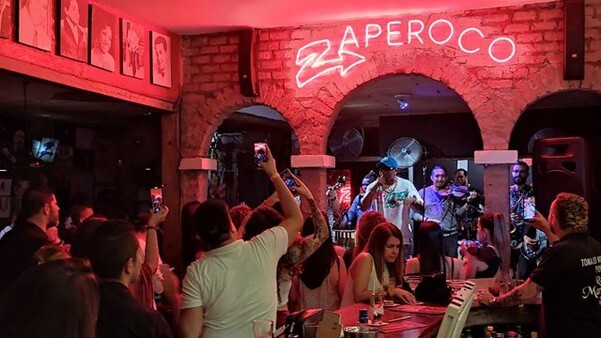
While Zaperoco is not as famous as the other bars above, it is located in the hipster haven of Granada, one of the best neighbourhoods in Cali for travellers.
 Salsa schools in Cali are so numerous that it can be dizzying and overwhelming finding one. Before starting your research, define what you are looking for.
Do I want group classes or private lessons?
If you are short on time and want to learn as quickly as possible, private lessons are the way to go. However, if you want to mingle with other Colombians and make friends, group classes are the best.
What type of salsa dancing do I want to learn?
Some schools focus solely on salsa caleña, which is a side-to-side style with complex footwork.
Other schools teach the on1 style, salsa en linea, which is the international style with front-to-back movements, less footwork and more spins. Also, some salsa schools specialize in teaching social dancing skills, perhaps the best option.
Where are the salsa classes located in Cali?
Salsa schools are dotted around the entire city, but some parts of the city are less tourist-friendly. All recommendations in this guide are centrally located near tourist zones or within a ten-minute taxi radius.
Many of the best dance schools do not have official websites. They operate solely through Facebook, Instagram and WhatsApp. Almost all classes are taught in Spanish, so it helps if you can understand, but it is certainly not required.
Manicero is one of the more economical places to quickly level up your salsa game with group classes for all skill levels.
Calle 5 #39-71, Cali.
La Escuela de Baile has group classes are similar to those of Manicero, but the space is smaller and is slightly more informal. This means if you are struggling, you are more likely to receive personal attention. Most classes focus on steps you can use in social dance with occasional choreography elements sprinkled in.
Calle 9 #36a Bis 08, Cali.
Joy Dance is more of a school for bailadores, social dancers.
Their classes focus strictly on dance moves you can do with any partner you meet in the salsa clubs. Unlike Manicero and La Escuela de Baile, Joy Dance classes build off one another. That means you need to be able to commit to class each week.
Joy Dance is unique in that it dedicates Mondays to practice and review. This is helpful because it is easy to forget what you learn in class if you are not practicing regularly.
Calle 2B #18-00, Cali.
Swing Latino is the most prestigious salsa school in Cali. Many Swing Latino-trained dancers star in Cali’s famous cabaret shows. There is a strict, formalized training program focused on salsa caleña, including acrobatics. It has six levels and each level lasts four months.
Swing Latino makes the most sense for those staying in Cali long term and who want to become professional Cali-style salsa dancers.
Carrera 31 #7-25, Cali.
Salsa Pura and Arrebato Caleño are two other reputable salsa schools popular with foreigners. If their location and class schedule fit your needs, they are worth looking into.
Like to create or customize a fantastico package tour of Colombia? Use our Plan My Trip page to start planning your dream Colombian vacation now!