
CARIBBEAN COLOMBIAN CULTURE TOUR
The Caribbean region of Colombia is located in the northern part of the country, bordering the Caribbean to the north, Panama to the west, Venezuela to the east and the Andean region to the south. It has a population of over nine million people and is made up of the eight departments of Atlántico, Bolívar, Cesar, Córdoba, Magdalena, La Guajira, Sucre and San Andrés and Providencia.
This region also offers a huge cultural variety. The people at the coast are mostly referred to as costeños and are very proud of their origin. They are particularly famous thanks to their celebrations and festivals, celebrating almost everything, with the Carnival of Barranquilla as one of the best examples.
Hosting the oldest cities of Colombia, Santa Marta and Cartagena, you are at the right destination if you are looking for pre-Hispanic history or experiences with indigenous cultures.
Close to Santa Marta are found the former Tayrona culture with archaeological sites like the Ciudad Perdida, The Lost City. The Kogui and Arhuacos tribes in the Sierra Nevada de Santa Marta, the Wayuu in La Guajira and the Embera close to the Darian are just some examples of indigenous cultures still active nowadays.
The Caribbean region is full of small traditional pueblos and larger towns. Some of them have been declared National Cultural Heritage sites. Wandering around in pueblos like Mompox, Lorica or Cienaga is like going back hundreds of years in time, or being part of one of the books of the celebrated Colombian author, Gabriel Garcia Marquez.
Add to this the different gastronomical options, some of the most charming colonial coastal pueblos and you have it all when looking for some culture during your stay in Colombia. To participate in one of the fabulous festivals, one is spoilt for choice. Carnival de Barranquilla is probably the most famous, but do not forget to add to your list El Festival de Verano in Santa Marta, or Festival de Vallenato in Valledupar.
CULTURAL HERITAGE:
MOMPOX, CARTAGENA, SANTA MARTA, LORICA, CIENAGA AND CUIDAD PERDIDA
Mompox
Santa Cruz de Mompox, located in the swampy inland tropics of northern Colombia’s Bolívar Department, was founded about 1539 on the Magdalena River, the country’s principal waterway. Mompox was of great logistical and commercial importance, as substantial traffic between the port of Cartagena and the interior travelled along the river.
Perched along the banks of the River Magdalena, Mompox played a key role in the Spanish colonization of northern South America. From the 16th to the 19th century the city developed parallel to the river, with the main street acting as a dyke.
The historic centre has preserved the harmony and unity of the urban landscape. Most of the buildings are still used for their original purposes, providing an exceptional picture of what a Spanish colonial city was like.
The historic centre of Santa Cruz de Mompox’s identity as a Spanish colonial river port defines the unique and singular character of its monumental and domestic architecture. Most of the houses retain important features such as decorated portals and interiors, balconies and galleries. The special circumstances of the development of the city along the river have given it a quality with few parallels in this region.
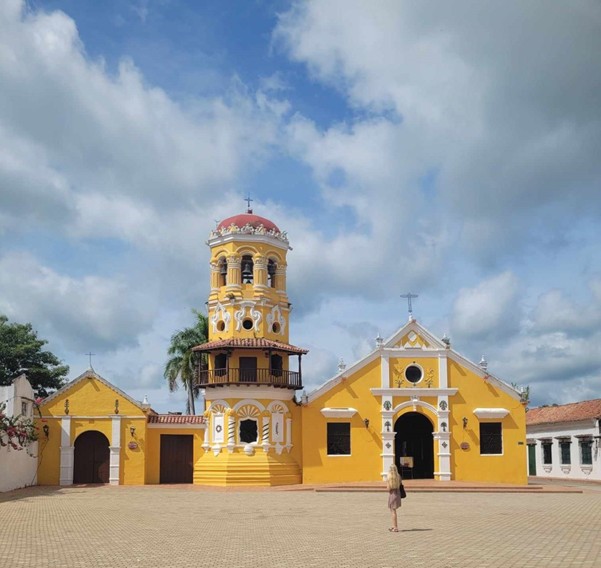 Mompox
We work with and recommend booking flights with www.kiwi.com
Cartagena
Situated along the northern shores of Colombia on a sheltered bay facing the Caribbean, the city of Cartagena de Indias boasts the most extensive and one of the most complete systems of military fortifications in South America.
Due to the city’s strategic location, this eminent example of the military architecture of the 16th, 17th and 18th centuries was also one of the most important ports of the Caribbean. The port of Cartagena, together with Havana and San Juan, was an essential link in the route to the West Indies from Europe and thus an important chapter in the history of world exploration and the great commercial maritime routes.
Cartagena was for several centuries a focal point of confrontation among the principal European powers vying for control of the New World. Defensive fortifications were built by the Spanish in 1586 and were strengthened and extended to their current dimensions in the 18th century, taking full advantage of the natural defences offered by the numerous bay-side channels and passes. Presently, on the narrow streets of the colonial walled city, civil, religious and residential monuments of beauty and consequence can be found.
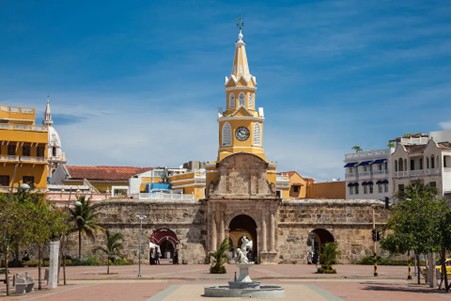 The Walled City, Cartagena
Santa Marta
Santa Marta is the oldest surviving city in Latin America, dating back to July 29, 1525, during the days of Spanish Conquistador Rodrigo de Bastidas. With a population of around 500,000, the city of Santa Marta is far from the largest city in Colombia. However, its importance as a tourism destination is not built on size, but rather on its ability to serve as a multifaceted gateway to nature, history and culture.
As the oldest colonial city in Colombia, Santa Marta is an ideal destination for history fans. Explore fascinating historic sites, including the Museo del Oro Tairona, Tairona Gold Museum, which is housed in a historic former customs house that dates to 1730 and exhibits pre-Columbian gold and pottery, as well as hundreds of other artifacts.
Just a few blocks away is the Cathedral of Santa Marta, which was originally founded in 1531, although its current structure dates to the 18th century.
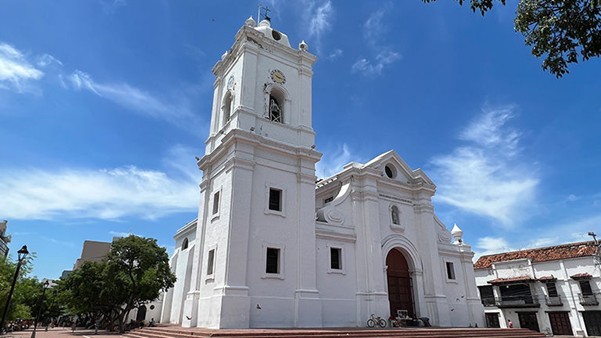 Cathedral of Santa Marta
La Quinta de San Pedro Alejandrino is the place where Simón Bolívar, the much-celebrated liberator of this region of South America, spent his final days.
This historical landmark is now a museum and cultural centre.
Santa Marta is also a gateway for learning about diverse cultures. Four Indigenous communities, Koguis, Arahuacos, Wiwas and Kankuamos call this area home.
Among the most fascinating and indeed physically demanding ways to learn about local Indigenous history is to visit the Ciudad Perdida (Lost City), the ruins of a civilization in the northern Sierra Nevada that date to sometime between AD 500 and 700.
Lorica
As the second-largest city in the department of Cordoba, Lorica is a patchwork of architectural styles, from the Republican charm of the waterfront to modern office buildings in the center. A few hours northwest of her colonial little sister, Mompóx, Santa Cruz de Lorica was also once a buoyant trading pueblo for everything from textiles to nuggets from the alluvial gold mines. Its name originates from pre-Columbian times, when Lorica, the indigenous chief of the Zenú tribe, governed over these wetlands.
Lorica’s age of splendour is linked with the arrival of people from the Middle East. As the Sinú River opened its floodgates to immigration in the mid-19th century, a dock and covered boardwalk were constructed. The pueblo became known as the Pueblo Arabe (Arab Town) in honour of its Lebanese and Syrian settlers.
The pueblo of Lorica is close to the beach municipalities of Tolú and Coveñas on the Morosquillo Gulf. Even though they are far less frequented than those further up towards Cartagena and Santa Marta, they offer visitors plenty of opportunities as well as the possibility of exploring San Jacinto, with its artisanal hammock industry or San Antero, where every year locals host a donkey festival.
For many decades, Lorica was off the traveller’s map, given the fighting between paramilitaries and guerrillas in the nearby Montes de María range. Given the enhanced security situation, the pueblo’s beauty has yet to be fully explored.
 Santa Cruz de Lorica
Begin organizing your dream Colombian getaway right away by using our Plan My Trip page!
Cienaga
Cienaga is considered one of the most beautiful pueblos in all of Colombia and was the setting for the inspiration of the book One Hundred Years of Solitude, by famous Colombian author Gabriel Garcia Marquez. Walking through the streets and plazas of Cienaga, you can bring to life the characters and events that are narrated in the book.
Founded in 1751, Cienega was declared a Pueblo Patrimonio, Heritage Town, in 2012 for its history, culture and architectural richness. Within its architectural heritage, you can find the Chapel of the Santa Teresa School, the Old Railroad Station, the Church of San Juan Bautista, the Masonic Lodge and the Casa del Diablo, House of the Devil.
At the cultural level, its main events are the Cienaguero Cayman Festival held every January 20th and the National Guitar Music Festival that pays tribute to Guillermo Buitrago every June.
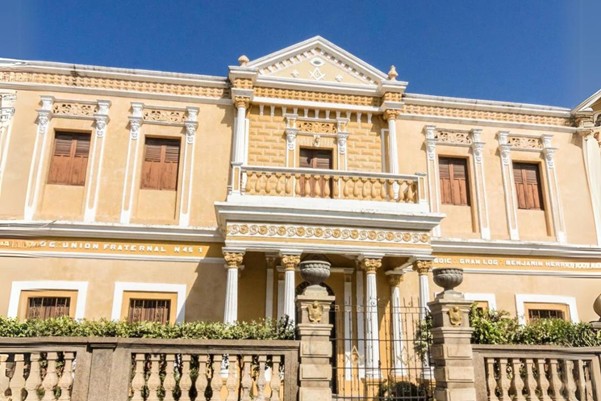 Cienaga
Cuidad Perdida
In the rainforests of Colombia’s Sierra Nevada de Santa Marta, the archaeological remains of a spectacular city built over a millennium ago by the Tayrona civilization.
Constructed using rammed earth and intricate masonry, the city was abandoned due to pandemic cycles throughout the Americas in the sixteenth century, when the Tayrona polities lost up to 90% of their population due to disease.
In 1975, the overgrown remains of the site were stumbled upon by bandits, bringing it to the attention of scholars and the Colombian government, but much remains to be learned about its composition and development.
Today, Ciudad Perdida stands as a poignant reminder of the complex and often tragic interactions between indigenous cultures and European colonizers during the age of exploration.
The effects of colonization can still be felt. After the Tairona fled, the Spanish took more and more of the gold that had once belonged to this proud people, until nothing was left.
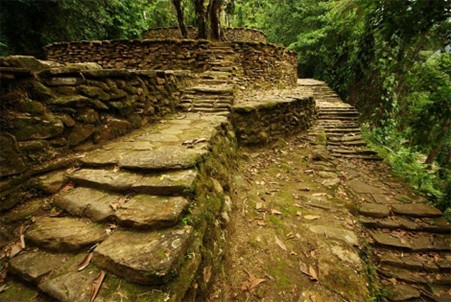 Cuidad Perdida
Like to create or customize a fantastico package tour of Colombia? Use our Plan My Trip page to start planning your dream Colombian vacation now!