
CHOCÓ/PACÍFICO CULTURAL TOUR
The Chocó/Pacífico region is in the northwestern part of Colombia, with its borders being the Pacific Ocean to the west, Panama to the northwest, the Andes to the east and the Nariño and Cauca departments to the south. It has a population of over 700,000 and comprises the Chocó department and the northern part of the Valle del Cauca.
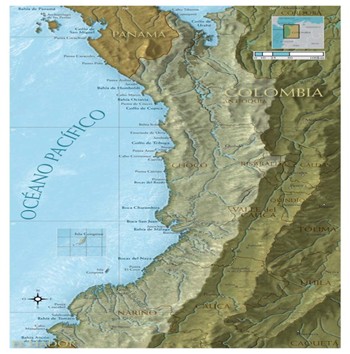
Chocó and Valle del Cauca are the two departments that comprise this region. The Pacific Region is an area in which largely black communities still co-exist today. They preserve intact many of the cultural traditions of their African origin, including the way of dressing.
Their dances and music are closely linked to their heritage and characteristic of the area. Here, the sea merges with the jungle and sugarcane fields, while marimbas, currulaos and trumpets play the best salsa that generates an ever-beating rhythm.
Colombia’s Pacific territory, now known as Chocó, has been inhabited by indigenous nations for thousands of years. Archaeologists have found evidence of ancient settlements along the region’s three main rivers.
In the Gulf of Urabá and along the Atrato River live the Kuna or Tule people. The San Juan River region was inhabited by the Wounaan or Noanamaes. The areas around the Atrato and the Baudo rivers was home to the Emberá, Baudoes and Citararaes. Chocó is where Spanish conquistadors built their first settlement in the Americas. Chocó was initially the name given to these groups by Spanish conquistadors. When the conquistadors arrived, many of the Emberá people fled to the Darien jungle around the Panamanian border. The majority of initial inhabitants were killed by the Spanish or died of European diseases. Today, indigenous communities make up just 13% of Chocó’s population.
Chocó is predominantly home to descendants of slaves and indigenous communities that survived the Spanish conquest and subsequent armed conflicts. Chocó runs along the northern half of Colombia’s Pacific coast and stretches up to the border with Panama. After centuries of exploitation, the province is now the poorest in Colombia. If you want to experience the charm of humpback whales along the Pacific coast, this is your destination.
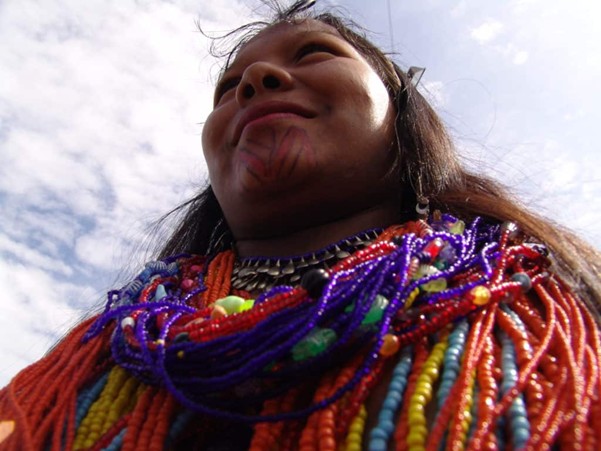 Emberá Indigenous
In the most northern part of Chocó, the Spanish built their first formal town on the American mainland, Santa Maria de la Antigua del Darien, but later abandoned it. Archaeologists have been unable to exactly pinpoint the remains of this historic settlement. Pacific culture has its roots in pre-Columbian times, before the arrival of the Spanish in the 16th century. Different indigenous ethnic groups have long lived in this region, mainly the Emberá and the Awá. Chocó is a region of ancestral importance, occupied by five different indigenous tribes living in resguardos, reserves, alongside Afro-Colombian communities.
After the conquistadors discovered the region’s wealth of natural resources and minerals, they lacked the manpower to extract these riches through the dense jungles and adverse weather conditions. Their solution was slavery. Up to 7,000 slaves were appropriated from Africa and brought to Chocó over a hundred years, starting in the 1700s. They were used to working in the gold mines and on the banana plantations. As the colonial economy relied almost solely on gold, which Chocó has in abundance, the valuable mineral was extracted and transported to Europe.
However, it was not until the 17th. and 18th. centuries that the region began to develop economically thanks to the exploitation of sugar cane and other crops, which enabled the emergence of the new Pacific culture. However, the culture of the Pacific developed and consolidated in Colombia primarily during the colonial period. With the arrival of African slaves, a new course in cultural traditions was established, bringing with it music, dances, religions, gastronomy and traditions that soon mixed with those of the native peoples and Spanish settlers. Since then, this cultural mix has resulted in a unique and diverse culture, characterized primarily by a tradition with African-American nuances.
Today, local descendants of slaves continue to be active in mining, very much in the same way as their slave ancestors. As previously mentioned, communities of African origin still co-exist throughout the coastline that runs through this region, the result of colonization. The population of Chocó is unlike any other department in Colombia, with over 92% of its population being Afro-Colombian or Indigenous, living on collectively owned territory. Indigenous and Afro-Colombian communities depend on the river Atrato and its tributaries for their livelihoods, means of subsistence and cultural practices. For this reason, it is not surprising that the customs, folklore and way of life of these people are still impregnated today with the culture of their ancestors.
The culture of the Colombian Pacific is expressed through its folklore and history. The dances, music, gastronomy and even the way of dressing of the Chocóanos, Vallecaucanos, Nariñenses and Caucanos are strongly marked by the Afro-Colombian culture. In addition, this region is also home to many indigenous groups, of which the Emberá community may be the most prevalent. Indigenous communities such as the Emberá and Wounaan also have their own rich cultural expressions. Here you will find traditional currulao and chirimía music, as well as various culinary specialties.
The territory and its riches have long been fought over by other regional powers. Chocó was only officially established as an independent department in 1947. Chocó has been unfortunate with its aggressive and greedy neighbours. Instead of acting as allies to the department, Antioquia, Valle del Cauca and Caldas wanted to divide it up and disperse its riches. Between 1904 and 1947, Chocó lost over 27,000 square kilometres/10,425 square miles to its three neighbouring departments. Even after being officially recognized as a department in 1947, attempts to sabotage the region continued under General Gustavo Rojas’ military dictatorship. The dictator ordered Chocó to be eliminated as a department and divided between Antioquia and Valle del Cauca, but Pinilla’s intentions were thwarted by the 1957 coup d’état of General Gabriel París Gordillo, who reinstated civilian rule in Colombia.
Traveling to the Pacífico is, above all, a cultural experience and interacting with all these cultural elements will make any trip to this area unique. The Afro-Colombian culture has had a significant impact on the Pacific coast.
GASTRONOMY
Chocó is one of the areas in Colombia whose gastronomy is one of the richest and most varied, since it is found in the region richest in river and sea fish, due to its wide river network where an interesting variety of fish thrives.
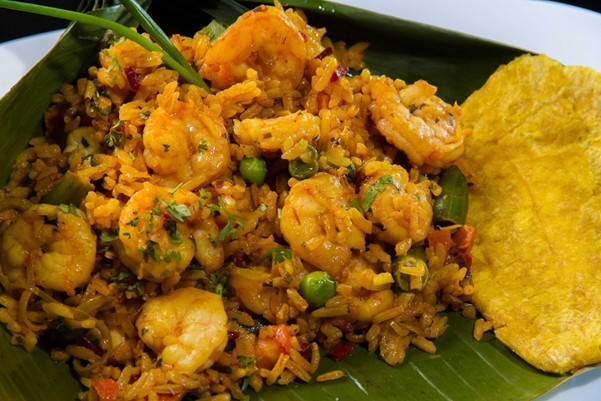
Its coasts, with the most beautiful coves and bays in Colombia, favor the proliferation of fish and shellfish dishes that constitute the nutritional base of the indigenous population and that they like to accompany with banana and yucca. It also has exotic fruits such as borojó and almirajó, with such magnificent flavour, from which charming refreshments are prepared.
The gastronomy of Chocó mixes Afro, mestizo and indigenous elements that give it a great variety of flavours and techniques. The most famous dishes are the sancocho of four meats (game meat, dried meat, smoked meat and chicken), rice with sausage, chontaduro with salt, patacón with cheese, smoked casing sancocho and wild cilantro, corvina tapao and fish encocados.
Another of the traditional dishes that must not be missed in Chocó is jujú. Comprised of fried green banana and cheese balls, they are perfect to eat as a starter or as a snack between meals.
Some of the typical Chocó drinks include borojó juice, cassava, coconut milk, chocolate and lulo. Among these drinks, a standout is the wine based on sugar cane, spices, herbs and roots.
CELEBRATION AND CULTURE
Hemmed in by exuberant rainforest where the Río Quito merges with the Atrato, before amplifying the water flow to the region known as the lower Atrato, Quibdó’s most recognizable landmark is the San Francisco de Asís Cathedral.
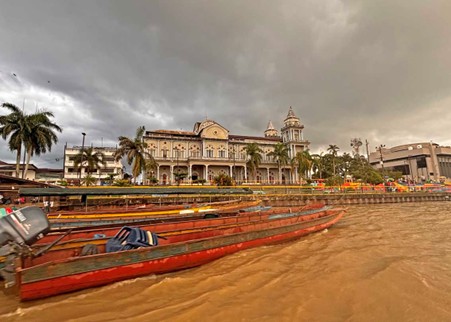 Cathedral of Saint Francis of Assisi
Completed in 1977 in honour of the city’s patron saint, San Pacho, it is indelibly linked to the early origins of this colonial outpost, when Franciscan missionaries first settled here on land gifted by the Emberá people. While the 17th-century settlement was destroyed by warring tribes, it was rebuilt by Jesuits. Since then, Quibdó has grown into a vibrant centre of Afro-Colombian culture and tradition.
The interior of the Cathedral is adorned with a beautiful wooden statue of Saint Francis and a mural by artist Maxi Lío Barreco, depicting the journey of missionaries through Chocó.
The cathedral remains a place of worship and spiritual hub for the community, reflecting Quindó’s commitment to spiritual devotion.
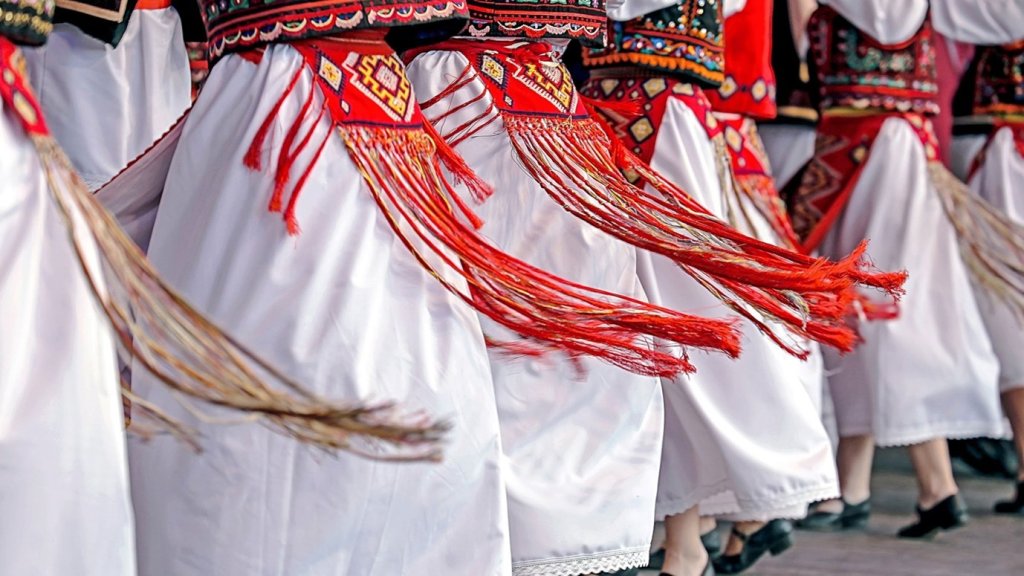
Every year, during the month of September, this devotion is on full display during the San Pacho Festival, when Saint Francis of Assisi makes his symbolic journey on the Río Atrato.
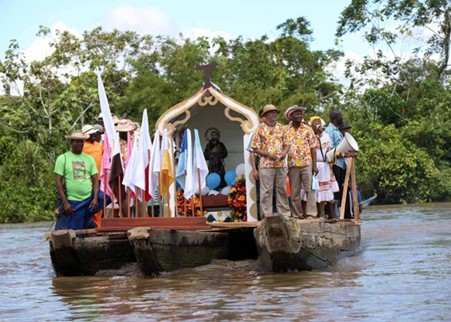 Saint Francis makes his annual pilgrimage on the Río Atrato
Recognized by UNESCO as part of the world’s Intangible Cultural Heritage, San Pacho is a month-long celebration that starts with processions, live music and joyful dancing in the streets.
From vibrant colours that splash across the city’s streets to food tastings inside the old market, Plaza de Mercado, even when San Pacho leaves the Atrato for another year, visitors can still enjoy a market, where much of the produce that is cultivated in the litoral makes it to the table, including the region’s exotic and potent aphrodisiac, borojó.
Choco Sonoro
One of the city’s most iconic structures is the Claretian Convent, known locally as the Episcopal Palace. Built in 1931, this elegant building is a masterpiece of republican architecture, featuring neoclassical columns, intricate arches and Moorish-inspired ornamentation that reflect the diverse cultural influences in Quibdó.
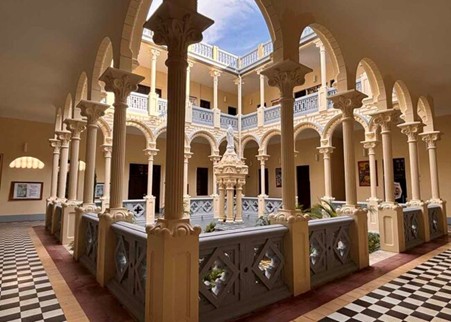 The ornate Claretian Convent in Quibdó
Overlooking the Atrato River at the northern end of the riverside promenade, the convent was designed by architect Luis Llach Langostera and completed by Claretian missionaries in 1943. Today, it stands out as both a cultural and historical landmark, bearing witness to Quibdó’s past while serving as a communal space for reconciliation.
The convent also houses a special chapel that has become a significant centre for commemorating the victims of Colombia’s internal conflict. This initiative, led by the Diocese of Quibdó, seeks to create a memory centre that honours the resilience of Chocó’s communities. The convent’s southern chapel has evolved into a space for reflection and remembrance, serving as a powerful reminder of the region’s ongoing journey toward peace.
With its UNESCO-listed San Pacho Festival and a blend of neo-republican and neo-gothic architecture, Quibdó in the Chocó/Pacific region is more than a destination. It is an immersion into what makes Chocó such an endearing yet often unseen territory within Colombia.
Like to create or customize a fantastico package tour of Colombia? Use our Plan My Trip page to start planning your dream Colombian vacation now!