
AMAZONAS NATURE TOUR
 We work with and recommend booking flights with www.kiwi.com
The Amazon, whose name is inspired by the warriors of Greek mythology, has always exalted the collective imagination. What traveller has not dreamed of going back to the sources of life on our planet, with the immensity of a fascinating river, images of giant trees, and magnificent animals in mind?
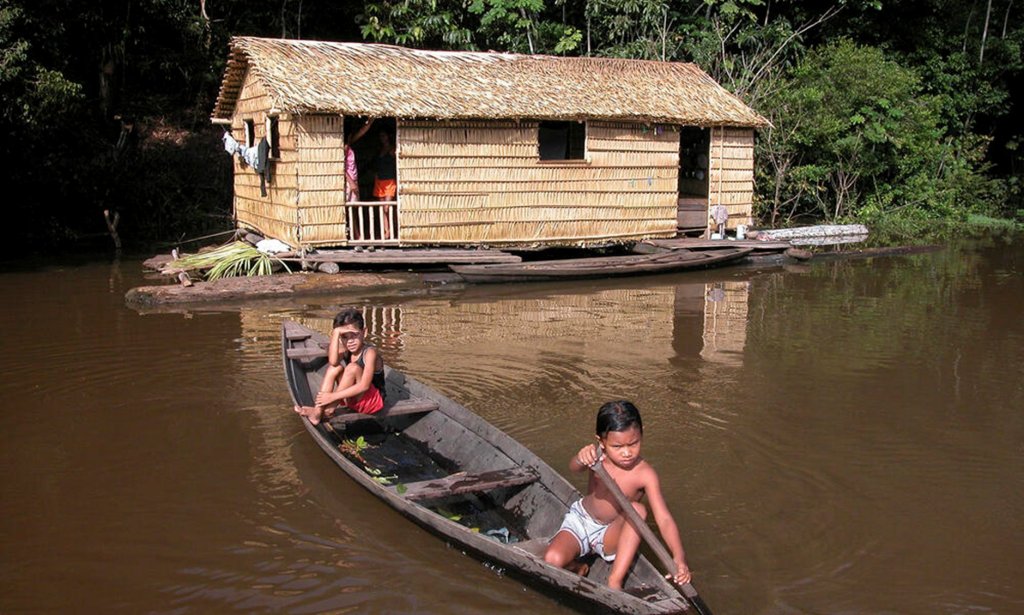
The true nature of the Amazon lies not in superlatives, but in the simple experiences that give all its dimension to a territory of legend: to travel in a dugout canoe through the flooded forest, to fall asleep in a hammock in the middle of the forest, to wake up to the cries of howler monkeys, to discover the Amerindian traditions.
You lose all sense of direction in the Amazon. Your guides and boatmen navigate using lily pads, overhanging branches, bends in tributaries: theirs is a world devoid of conventional signage. To outsiders, it can be discombobulating, but this is part of Amazon’s allure. Its gargantuan network of vegetation, waterways, and lakes is a beguilingly alien landscape, and this alone makes it worth the visit.
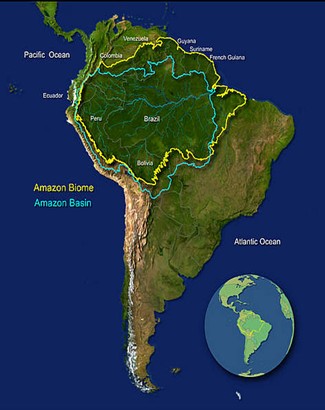
However, given that the Amazon Basin is almost equivalent in size to the USA, with territory reaching across nine different nations, deciding where exactly to go can be a challenge.
Wildlife viewing in the Amazon can yield up astonishing specimens, and it can also be notoriously unreliable. In some areas, it is difficult to see much in the way of heavy-footed mammals and rare birds. This is because most of the fauna journeys into the deep forest, where it can live undisturbed.
Instead, exploring the Amazon is about the little, incidental sights. It is about paddling past a tree and seeing six bats lined up on it, their wings folded and resting, spying a tiny kingfisher darting around or observing ranks of leaf-cutter ants march across the path carrying pieces of foliage far bigger than their bodies.
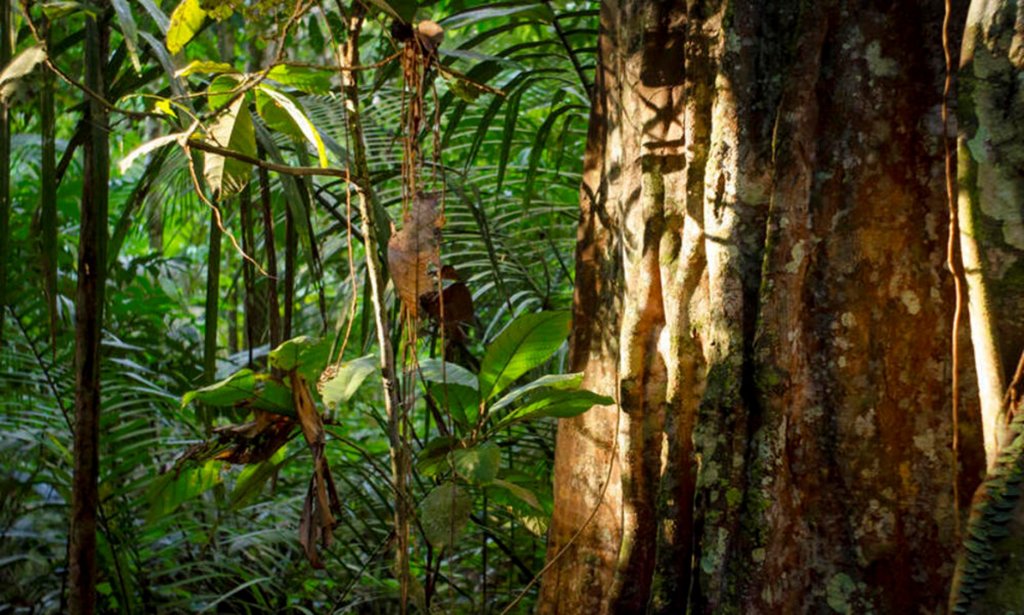
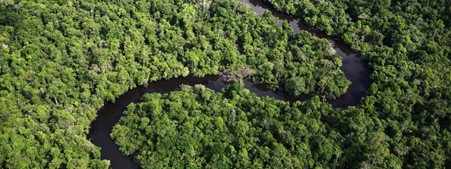
Then there is the whole sensory experience of being enveloped in the jungle. Walk paths thickset with lianas and be dwarfed by huge buttress roots. At times, travel along densely vegetated, seemingly impenetrable caños (tributaries) on small boats. Like entering a tunnel of trees, it is impossible to see the sky. However, open spaces do exist with oxbow lakes and clearings scattered around some areas.
It is the sounds of the rainforest that entrances, even somewhat oddly hypnotic. Sometimes it is eerily hushed, at other times the loud growls of a howler monkey, the crashing of unseen monkeys or birds through the trees, or the booming of cicadas.
There is a human side to the Amazon, too. Visiting the Amazon involves experiencing the character of its frontier pueblos, like Leticia, a liminal place where the barrier between civilisation and total wilderness feels thrillingly thin, with motor-taxis whizzing past decrepit Spanish colonial buildings and canoes crowding the piers. A dockside market heaves with the surrounding jungle’s bounty, including fresh cashews and bananas, coriander and even rare fish such as the pirarucu.
The Amazona pueblos are of interest to anyone looking to better understand the socio-economic situation of the heavily contested Amazon territory and its communities.
 Begin organizing your dream Colombian getaway right away by using our Plan My Trip page!
The Amazon rainforest is the world’s green lung, a beautiful but actually quite fragile region where strange and exotic birds and animals share their forest home with hunter-gatherer jungle tribes. This is where you can leave the industrialized world behind and disappear off into the jungle, or just take a boat ride up the world’s mightiest river, exploring the incredible wildlife and meet the indigenous people.
The Amazon is a vast biome that spans eight developing countries: Brazil, Bolivia, Peru, Ecuador, Colombia, Venezuela, Guyana, and Suriname.
The landscape contains:
- about one in 10 known species on Earth
- 4 billion acres/5.6 billion acres of dense forests
- 20% of the world’s liquid freshwater
- 7 million square miles/700 million square kilometres in the Amazon basin, about 40% of South America
There is a clear link between the health of the Amazon and the health of the planet. The rainforests, which contain an estimated 150 – 200 billion tons/13 – 18 billion kilos of carbon, help stabilize the local and global climate.
Deforestation releases significant amounts of this carbon, which has negative consequences around the world.
ANIMALS OF THE AMAZON
The Amazon is one of Earth’s last refuges for jaguars, harpy eagles, and pink river dolphins, and it is home to sloths, black spider monkeys, and poison dart frogs. It contains one in 10 known species on Earth, 40,000 plant species, 3,000 freshwater fish species, and more than 370 types of reptiles. Over 2,000 new species of plants and vertebrates, including a monkey that purrs like a cat, have been described since 1999.
BIRDS OF THE AMAZON
Home to more than a thousand different species of birds like hummingbirds, channel-billed toucans, hoatzins, and macaws, the Amazon is one of the most diverse areas for birds in the world. Mitú offers world-class birding for beginners and experts.
Here, some of the most special birds and many of the restricted species to this area and ecosystems in this particular part of the country can be seen. Macaws, an icon of the Amazon, are highly intelligent and social, living in flocks of 10 to 30 birds. They mate for life and can live up to 60 years. Some species can even mimic human speech. Sadly, macaws are under threat from deforestation and the illegal pet trade.
HIKING
Hiking is one of the main activities on a trip through the Colombian Amazon. It allows you to explore the jungle, spot native species, and move to your next point on the itinerary.
The Puerto Nariño to San Martin de Amacayacu route stands out among the best trekking routes in the Colombian Amazon. Another famous route is the Ruta Wayruru, of 9.2 km/5.7 miles and also of moderate intensity. The route passes through the indigenous community of Ziera Amena, a good opportunity to immerse oneself in the local culture. A route of 8.5 km/5.3 miles of moderate intensity takes about 3 hours to cover.
This is an exciting and unique experience for nature and adventure lovers. Following the trails, you get to explore the lush forests. Along the way, you discover unique plants and animals and immerse yourself in the local indigenous culture.
AMACAYACU NATIONAL NATURAL PARK
Amacayacu National Park is located in the Amazon region and thus differs largely in climate and landscape from all the other parks. The scenery is characterized by the flooded tropical rainforest, so prepare yourself for high temperatures and humidity.
The protected forest is home to more than 5,000 species of plants, as well as being the region with the greatest diversity of primates on the planet and the different climate makes the Amacayacu park a place to experience unique flora and fauna. To get an even closer look at the animals, you can also explore the park with a canoe.
The appearance of the park is dominated by the wet and dry seasons. The wet season occurs approximately in the first half of every year, and the dry season starts in August/September. In the dry season, you will be able to see more animals and partake in more activities.
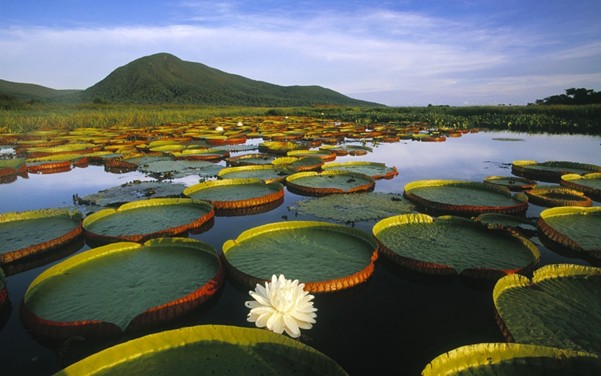 Victoria amazonica
It is the habitat of the Pygmy marmoset (Callithrix pygmaea), the smallest primate in the New World, the largest water lily in the world (Victoria amazonica), the giant silvery-blue butterfly Menelaus blue morpho (Morpho menelaus), and hundreds of more species.
There are four hiking trails in the park:
- Chagras Trail
On this trail, you can observe the crops cultivated by the indigenous and the production techniques. - Selva (Jungle) Trail
A tour through the Amazon jungle to appreciate the most diverse number of Amazon’s plants and animals, such as primates, mammals, and a great variety of birds. - Aquatic Trail
Diurnal or nocturnal tours that cross the Amacayacu River and the Matamata Creek. On these tours, you can understand the different aquatic mammals such as the pink dolphins or Amazon river dolphin (Inia geoffrensis) and the Amazonian manatee (Trichechus inunguis). - Miquiando (Monkey) Trail
In the Mocagua indigenous reserve, the Maikuchiga Foundation offers a tour where you can learn about the 9 species of primates present in this part of the Amazonian trapeze. In the foundation, there are specimens that have been rescued from illegal trafficking.
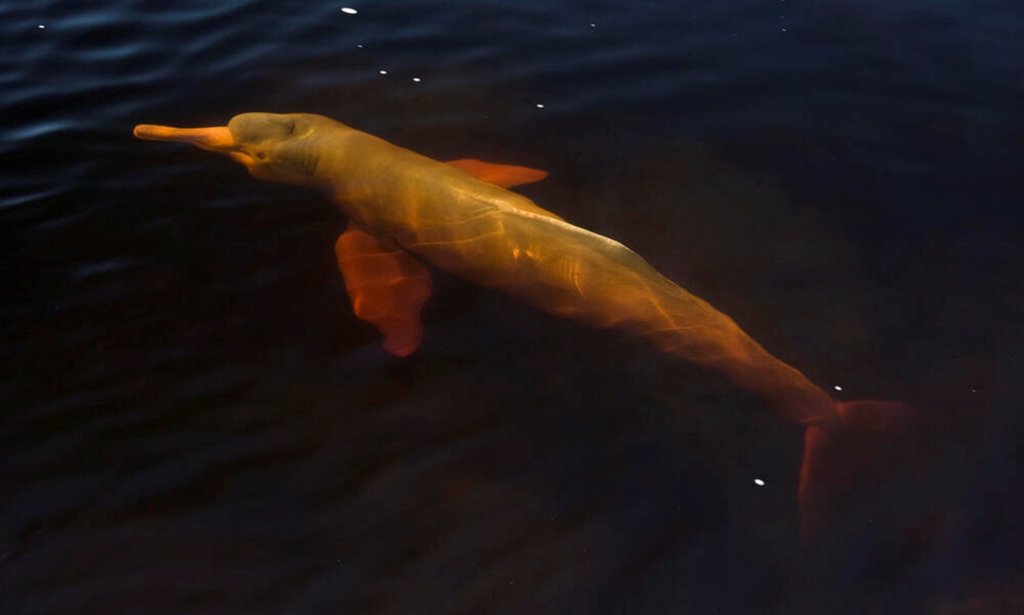 Pink Dolphin
Pink Amazonian Dolphins
These are one of those mythical animals found only in a handful of Latin American countries and once again Colombia is one of the lucky destinations that can boast several species of river dolphin.
Seeing river dolphins is one of those unique travel experiences you can have if you take the trouble to visit the vast expanses of the eastern plains or the Colombian Amazon jungle.
Dancing elegantly in Colombia’s fresh waters, river dolphins are endemic to the Orinoquia and Amazon regions. Their sightings are limited to these regions and they generally travel in groups, stalking schools of fish to feed. There are two types of river dolphins in Colombia: pink dolphins, which can also appear to be grey and grey dolphins, which can have a pink tint. It is their size that distinguishes them.
The best place to see pink dolphins in the Amazon is Puerto Nariño and Lake Tarapoto, near Leticia.
Leticia is the capital city of Amazonia department, intersecting with Peru and Brazil along the Amazon River, the longest and widest river in the world.
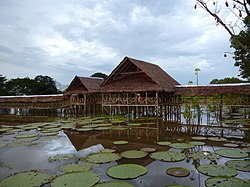
Leticia is located in the heart of the Colombian Amazon, the largest wet tropical forest in the world. Today, Leticia is the springboard for exploring the Amazon. Flights from Bogotá are the only way of gaining access to the jungle.
Historically, Leticia was a Peruvian town used as a military base and an important river port. The legend says that the settlement was originally named by a soldier back in 1867 who fell in love with an Amerindian called Leticia. This territory was handed to the Colombians by treaty in 1924, although the two nations disputed ownership; the League of Nations awarded Leticia to Colombia in 1934.
Today, Leticia is Colombia’s southernmost town, is known as Tres Fronteras/Three Frontiers, as it is the point where three countries, Colombia, Peru and Brazil meet. The city is a popular tourist hub for adventure seekers, looking to explore the biodiversity, incredible wildlife and authentic cultural experiences in the lungs of the planet.
The Colombian Amazon is a perfect destination for those who want to experience nature in a way they have never done before, or for those who want to do something different and enjoy the biodiversity of the country.
This portion of Colombian paradise is an incredible place that invites you to get lost in it, with a mysticism and energy that fills one with tremendous vigour for daring to travel to these precious and blessed lands.
Like to create or customize a fantastico package tour of Colombia? Use our Plan My Trip page to start planning your dream Colombian vacation now!