
PUEBLOS PATRIMONIO HONDA
(Colombian Heritage Towns: Honda)
Exploring Colombia’s charming Pueblos Patrimonio (Heritage Towns) is akin to embarking on a fascinating journey through time.
Every cobblestone street, colonial facade, and Basilica tells ancestral stories, transporting visitors to bygone eras. From churches to plazas, these pueblos offer an authentic experience, preserving Colombia’s culture, architecture, and traditions.
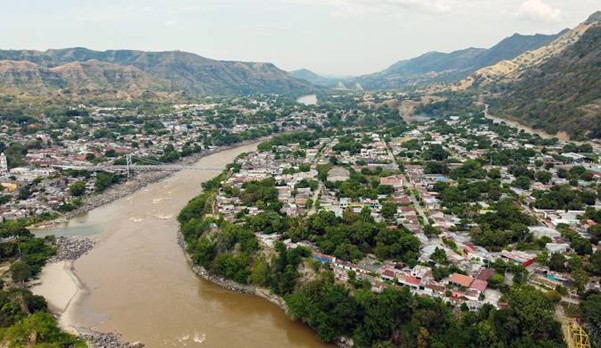
Honda, known as The City of Bridges, was designated a Pueblo Patrimonio (Heritage Town) in 2010. Honda, dating to the 16th century, was a key trade hub for the rich mines of Mariquita.
 We work with and recommend booking flights with www.kiwi.com
HONDA
“The Rio Magdalena is not just the country’s main artery; it’s the reason Colombia exists as a nation… the Magdalena is both a corridor of commerce and a fountain of culture, the wellspring of Colombian music, literature, poetry and prayer.”
Wade Davis, Magdalena: River of Dreams: A Story of Colombia.
Positioned at the confluence of three waterways – the Gualí, Guarinó and Magdalena rivers, the pueblo of Honda is a hidden gem that promises a captivating journey through Colombia’s rich history and vibrant culture.
Often overshadowed by more renowned destinations, this enchanting pueblo delivers an authentic Colombian escape, from its foods and fiestas to deep historical ties.
Honda, Tolima
In the 19th century, Honda’s location on the Magdalena River made it a key Colombian trading post. It was the last navigable port southbound, moving goods from Barranquilla to Colombia’s interior.
Steamboats docked at Honda, where workers moved freight to Bogotá by mule.
This bustling trade hub fuelled Honda’s growth and played a crucial role in the colonization of Colombia’s coffee region. Visit the Museo Río Magdalena to explore the town’s historical significance.
CLIMATE AND WEATHER
In Honda, the summers are short, hot and humid, while the winters are likewise fairly short, warm and muggy. The weather remains mostly wet and overcast year-round.
Temperatures range from 24°C (75°F) to 34°C (93°F), rarely dropping below 22°C or rising above 38°C.
The hot season lasts from late July to mid-September, with daily highs averaging above 34°C (93°F). The hottest month of the year in Honda is August, with an average high of 34°C/93°F and low of 24°C/75°F.
The cooler season lasts for 2 months, from mid-October to mid-December, with an average daily high temperature below 32°C/89f.
The coolest month of the year in Honda is November, with an average low of 24°C/75°F and high of 32°C/89°F. The wet season lasts from mid-March to early December, with over a 58% chance of rain each day. The month with the most wet days in Honda is October, with an average of 24 days.
The dry season lasts 3 months, from December to March. The month with the fewest wet days is January, with an average of 12 days.
The muggy period lasts from late September to July, with a discomfort level lasting 56% of the time. Honda is at an elevation of 229m/751 feet and has a population of about 32,000 people.
When visiting Honda, it is best to wear light tropical clothing with comfortable shoes for walking around the pueblo. We highly recommend wearing a wide-brimmed hat and using high-factor sunscreen.
THINGS TO SEE
The Spanish conquered Honda in 1540, once home to the Ondama and Gualí peoples, as seen in ruins. By the mid-17th century, the pueblo had become an important and prosperous part of the colonial enterprise, and an obligatory stopping point for all boats on their journey along the Magdalena River.
The barrio Alto del Rosario is a warren of cobbled, steep streets dating from this time. The houses have thick stone walls, elegant wooden window frames with balconies and imposing doors, opening onto cool interior patios with abundant vegetation.
There is a Mediterranean, Moorish feel, reminiscent of Seville or Córdoba and a pleasing mix of decrepitude and, in some cases, tasteful restoration. Known as The City of Bridges, Honda’s impressive collection, forty to be exact, showcases diverse architectural styles from simple stone to intricate iron masterpieces.
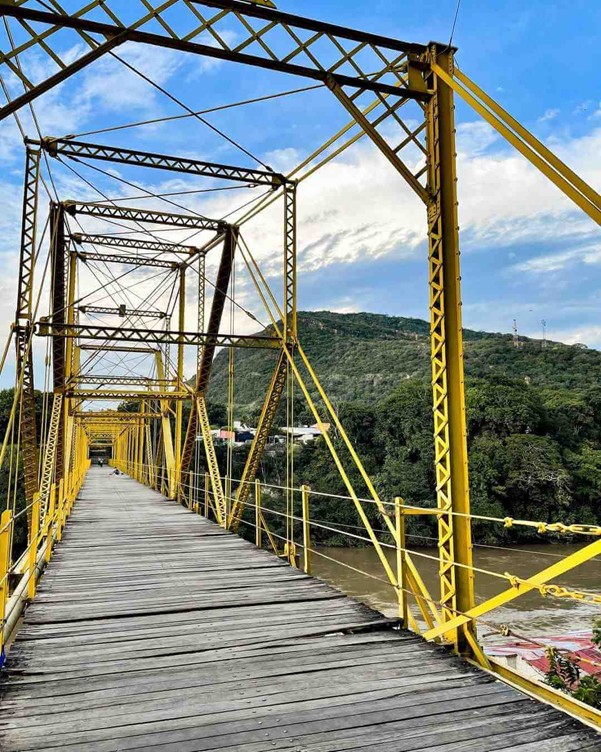
The Navarro Bridge, constructed in 1899, is a testament to Honda’s pioneering spirit as the first iron bridge in South America. The San Francisco Bridge Company of New York, which also built the Golden Gate Bridge, produced its iron and steel structure.
 Navarro Bridge
The iconic yellow bridge spans 167m/548 feet in length, is 5m/16 feet wide and 18m/59 feet high. It stands at the head of the rapids of the Magdalena River, known as the Salto de Honda.
Declared a national monument, the Navarro Bridge symbolizes the town’s connectivity and its pivotal role in Colombia’s maritime history.
A walk across the bridge as the sun sets over the surrounding hills is an uplifting, exhilarating experience. Caution is necessary with the holes in the planks, through which one could easily slip into the river below.
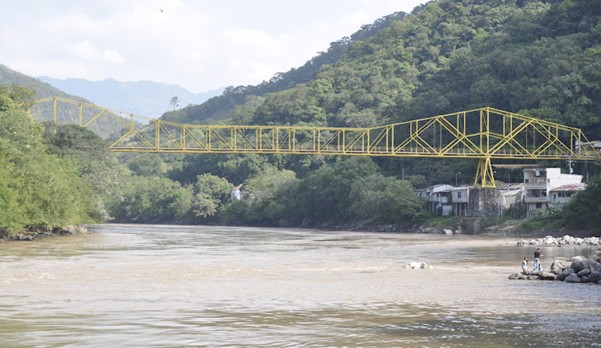
Another significant bridge is the Luis Ignacio Andrade Bridge, the Puente del Carmen. Built by engineers Cayo Antonio Mazorra and E. Santos Potess, it extends to 260m/853 feet and was opened in 1952 during the presidency of Dr. Mariano Ospina Pérez.
Named in honour of Dr. Luis Ignacio Andrade, a prominent government minister and politician of the era, this bridge is a landmark of engineering and political history.
The longest bridge in Honda, Puente López, was originally called Puente de San Francisco. The original bridge, dating back to the colonial era, appears on the pueblo’s coat of arms. Destroyed by the 1805 earthquake and replaced by a wooden structure that collapsed in 1902, Puente López remains a symbol of Honda’s enduring spirit.
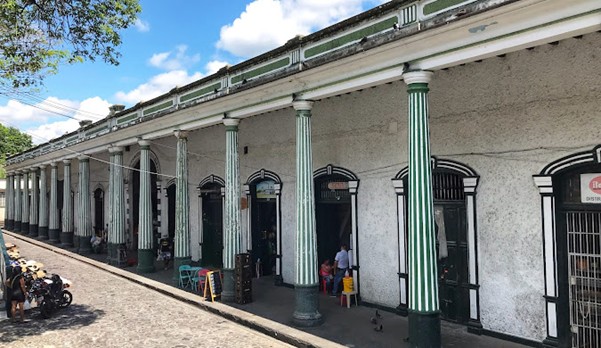
At the heart of Honda lies its vibrant Mercado Central. With its white façade and 148 Corinthian columns, the market is a visual feast, where locals buy and sell fresh produce, handmade crafts and various other goods.
English engineer Harry Valsint constructed the building from 1917 to 1935. The vibrant colours of tropical fruits, the aroma of freshly ground coffee and the lively banter of vendors create an absorbing cultural experience.
On the walls of this market are giant murals that pay tribute to local people. Make sure to try one of the market’s outstanding delicacies–the tamal tolimense.
 Mercado Central
Honda’s well-preserved architecture tells the story of its storied past. Colonial and Republican-era buildings line the cobbled streets of the old quarter. Among the most well-preserved is Calle Las Trampas.
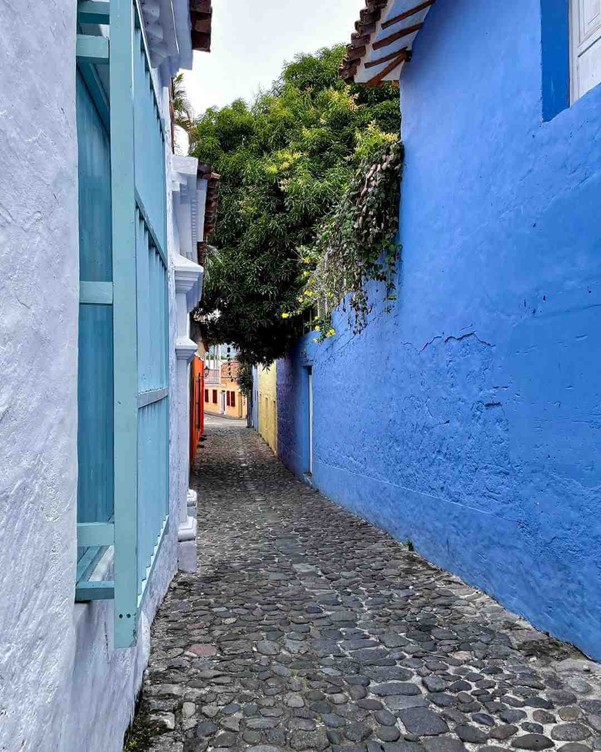
The Teatro Unión stands as an impressive symbol of Honda’s cultural and artistic heritage. This historic theatre from the 1920s, with its stone façade and details from the Golden Age of silent film, continues to be a central venue for performances, movies and cultural events.
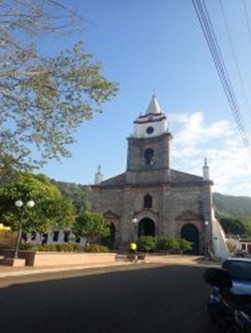 Nuestra Senora del Rosario church
The Cathedral of Our Lady of the Rosary, with its pristine white façade and ornate interior, stands as a majestic example of colonial architecture, inviting reflection on the town’s spiritual heritage.
Equally impressive is the Church of San Francisco, dating back to the 17th century, which features a gloriously tranquil courtyard.
Another notable landmark is the Farmacia Nueva Arturo Cerón, one of the first pharmacies in Colombia’s interior. Established in the early 20th Century, it served the medical needs of the local population and muleteers traversing the central Andes range. Today, it symbolizes Honda’s commitment to community well-being and historical continuity.
A visit to Honda would be incomplete without exploring the Trilladora Gualí. Once a bustling coffee depository over the Magdalena, this historic building now hosts art exhibitions, cultural events, and community gatherings, celebrating Honda’s heritage while embracing contemporary culture.
The Trilladora is also a good starting point to stroll along the boardwalk next to the imposing waterway.
Other places of interest include La Pilda, a brothel famous nationwide in the mid-20th century, to which it seems politicians and the wealthy from across the land would flock.
Also, the now defunct railway station, which was built at the turn of the 20th century by the Dorada Railway Company Limited and Cuban architect Francisco Javier Cisneros.
The Museo del Río Magdalena houses a simple but interesting collection in an old stable by the water’s edge.
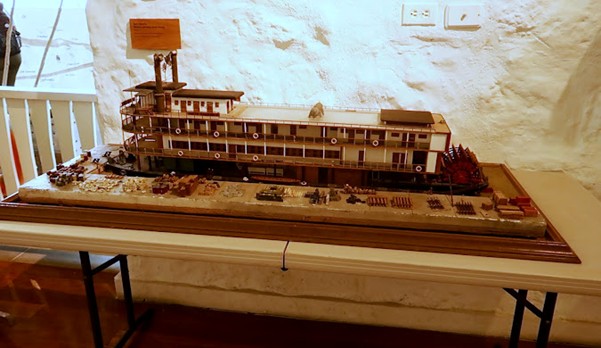 Museo del Río Magdalena
The Alfonso López Pumarejo museum, where Colombia’s former President was born and which houses a good collection of photographs and speeches.
Spend a fascinating half hour in the pueblo’s cemetery, where graves of British, German, American, Lebanese, and other foreigners from Honda’s prosperous mining, coffee, and agricultural booms are found.
GASTRONOMY
Lechona is a whole roasted pig, deboned and filled with a flavourful stuffing. This typically includes a mixture of rice, peas, onions and an assortment of spices.
Preparation begins with marinating the pig using seasonings such as garlic, cumin and achiote, which contribute to the dish’s distinctive taste. After marinating, chefs stuff and roast the pig for hours, resulting in crispy golden skin and a savory interior.
Though enjoyed throughout Colombia, many associate lechona especially with the Tolima Department. It frequently appears at festive events like Christmas and New Year’s celebrations.
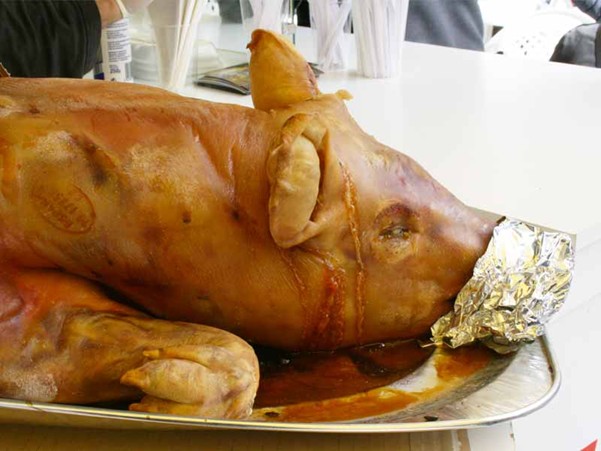 Lechona
Popular drinks:
- Masato
It is a fermented and traditional drink that comes from the pijaos, indigenous peoples of the area.
People make masato from cassava, rice, corn, and pineapple. Preparation consists of letting them ferment in a clay pot with water for several days and then sweetening them with molasses before serving. - Avena
This is the most common drink to find in Tolima, although you can readily find it in any part of the country. They make it with oats, cinnamon, sugar, milk, vanilla essence, and cassava (yuca) starch.
Mondongo is a soup made from tripe with potatoes, carrots and other vegetables. Cooked for several hours until the tripe is tender and flavourful, it is served with rice and avocado.
Mondongo is a hearty and filling meal.
Tamales have a pre-Hispanic origin and they are usually prepared in large quantities, given the number of ingredients and cooking time required. Enjoyed for breakfast, lunch and on special occasions such as Christmas or birthdays. They are always wrapped in a banana leaf.
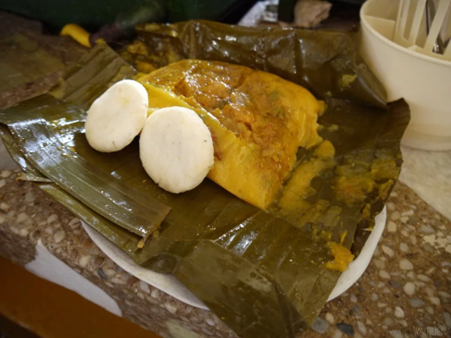 Tamales are found throughout Colombia, but Tolimenses are the best
Honda may not boast the fame of Cartagena or Bogotá, but its unique charm and historical significance make it a hidden gem worth discovering.
The pueblo’s timeless beauty and cultural richness offer a profound and immersive travel experience. So, when planning your next trip to Colombia, be sure to include Honda in your itinerary. It is a journey through time and history that promises to leave an indelible mark on your Colombian experience.
Like to create or customize a fantastico package tour of Colombia? Use our Plan My Trip page to start planning your dream Colombian vacation now!