
HISTORY OF CUMBIA

Cumbia street dancers in Barranquilla
The story of Cumbia begins in the rich cultural landscape of colonial Colombia, a genre that has become synonymous with vibrant and spirited cumbias for dancing. From its humble origins on the Caribbean coast of Colombia, Cumbia has enriched the lives of millions of people across the Americas. Its infectious, yet simple rhythm has encouraged people to boogie for more than eight decades.
One of the most popular dances in Latin America, Cumbia has come a long way since its early development among African communities along the coast of Colombia. It is now played and danced in various guises in clubs, on bandstands and in the streets as far north as Mexico and south to Argentina, as well as being popular among Spanish-speaking communities in the United States.
So why has this music style become so popular in almost every Latin American country? The simple answer is, each country has created its own style of cumbias. Cumbia is easy to understand and straightforward to interpret because it is binary.
Cumbia, as a music genre, has many different styles depending on where it is played and countries across Latin America all have their own unique styles and additions to the music.
Cumbia music is most discernible for being percussion-heavy, with a signature double beat played on a maraca or drum and flutes that carry the melody.

African Cumbia Influences
The African influence on Cumbia is profound, brought about by enslaved African youth to Colombian shores. Victims of the colonial transatlantic trade, they made significant contributions to this great genre with the rhythm of their drums, called el bullerengue, which reflected the pain and anguish of their ancestors in resistance to their predicament. Instruments such as alemán and llamador drums provide the deep, resonant beats that are the pulse of cumbia songs.
This influence is evident in the energetic beats of cumbias sonideras and the pulsating rhythms in cumbias mix, compelling people to jump up and dance Cumbia. Thus, with the addition of the Indigenous wind instruments like the guacharaca, Cumbia was created.
Indigenous Colombian Contributions
The indigenous people of Colombia infused Cumbia with unique melodies and harmonies. The gaita, a traditional indigenous flute, is a distinctive element in cumbia colombiana. Its haunting sound complements the African drums, creating a fusion that is integral to cumbia music, crucial for those learning how to dance cumbia.
The lyrical part of cumbia is Indigenous, originally from the region of the Atlantic coast of Colombia in the Sierra Nevada de Santa Marta. Here, one of the ancestral tribes of America existed that made this great contribution to the Tayrona culture, who contributed the sound of the winds with their flutes.

Spanish and European Impact
Spanish colonization brought with it European musical elements, introducing string instruments and varied musical scales. This impact is particularly noticeable in cumbia sonidera and norteñas cumbias, where the harmonic structure reflects a more European style. Songs such as Baila Esta Cumbia by Selena and the works of artists like Margarita la Diosa de la Cumbia unmask this fusion.
The European influence is most evident in slightly later renditions of the style when instruments such as guitars, basses and horns were added, as well as the fact that Spanish has been the dominant language in most modern manifestations.
Cumbia has no borders; it is a cultural movement. It is the musical link that unites all the cultures of Latin America with that simple sound of the guacharaca that travels globally. People worldwide are hooked on this mystical rhythm, with its joyful and contagious spirit that brings a party atmosphere.
While cumbia was traditionally played by percussion, vocals and gaita flutes, modern cumbia is played by a full rhythm section of bass and piano, with a full complement of percussion instruments as well as brass, backing vocals and of course a lead vocalist.
Many musical styles throughout the world are the result of the fusion of different cultures and musical heritages. For example, in Cuba, this fusion led to styles such as son and rumba, in the United States, it led to blues and jazz, and in Brazil, it paved the way for samba. In Colombia, the fusion of African communities brought there as slaves by the Spanish and pre-Hispanic communities led to cumbia.
The best way to learn about any musical style is by listening to the music itself. So let us listen to and analyse two well-known examples of cumbia music, one traditional and one modern.
The first is a traditional song called El Pescador by Toto La Momposina
This version by Toto La Momposina is a great example of the use of traditional instruments. It does not have the poor audio and video quality usually associated with old recordings.
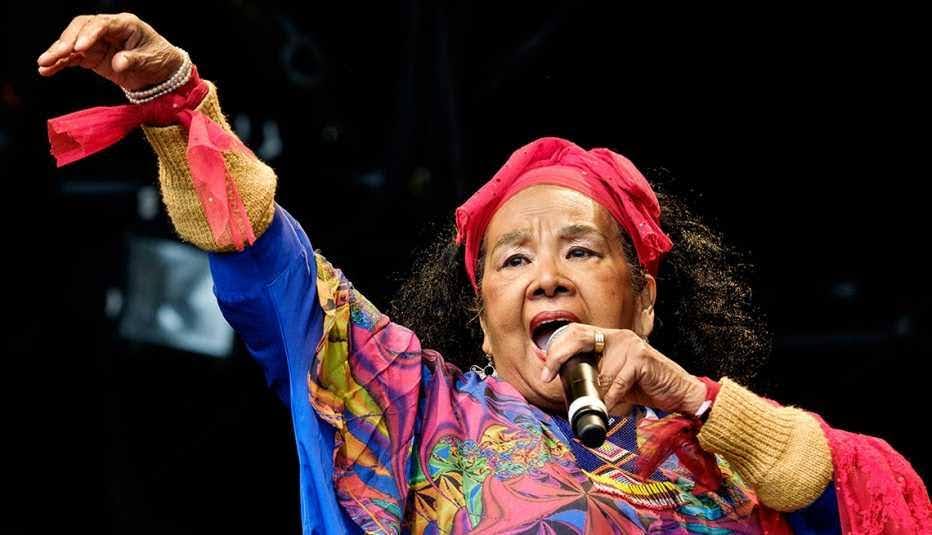
Toto La Momposina
The ensemble is dominated by percussion with tamboura, llamador, maracas and two alegre drums. Aside from the large percussion, Toto La Momposina is herself on lead vocals with a large backing chorus of male and female vocalists.
While Toto takes the melody and tells the story through her vocals, the chorus provides a rich harmonic backing. All the instruments are acoustic, which makes sense given that this was originally folk music played in small, usually poor communities.
Like most early cumbia music, this song is monophonic in the verses and homophonic in the choruses with the lead vocals singing in between the choral phrases. The percussion keeps a constant pulse throughout, a feature of African music as a whole.
For a more modern manifestation of cumbia, the song to listen to is the 1996 hit Como Te Voy a Olvidar by the cumbia group Los Angeles Azules. This is a good example of the international success of cumbia.
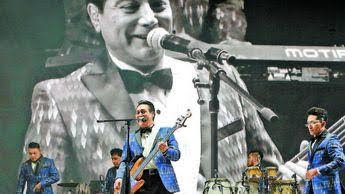
Los Angeles Azules
Take notice of the venue, a huge arena that seems to be sold out, which shows how popular this music has become. Also, the video itself has over 240 million views, while Los Angeles Azules have almost 10 million subscribers on YouTube.
As for the music itself, the instrumentation is far more modern and varied. The percussion section is still large but features more modern Afro-Cuban instruments such as congas and timbales as well as guiras played by backing vocalists. While there are no maracas, the rhythm played by the guiras approximates this sound fairly closely. The congas play a blend between the llamador and the tamboura rhythm.
There is a large rhythm section of electric bass guitar while the accordion plays a similar role to the brass (two trumpets and two trombones) and plays melodic lines towards the end of each vocal phrase. The song follows a more conventional pop verse/chorus structure, which is dominated by the lead vocal melody and does not feature backing harmony like that of El Pescador.
These examples give a clear insight into the journey cumbia has taken, from small coastal communities in northern Colombia to massive arena concerts in the Americas and beyond.
This amazing style of music has progressed a long way, although it still holds true to its musical origins. As can be seen and heard in the above examples, there is not just one way to play cumbia. By listening and learning about the origins of this music, it is possible to have a better idea of how it retains its originality.
Recommended Listening
Here are some important cumbia bands and artists that are worth listening to in order to get more deeply into this style of music:
Luis Carlos Meyer Cumbia Cienaguera
Los Gaiteros de San Jacinto Fuego de Cumbia
Toto La Momposina Rosa
La Sonora Dinamita La Colegiala
Los Angeles Azules Best of Los Angeles Azules
Selena Baila esta Cumbia
Celso Piña Cumbia Sobre el Rio
Like to create or customize a fantastico package tour of Colombia? Use our Plan My Trip page to start planning your dream Colombian vacation now!