
ORINOCO NATURE TOUR
 We work with and recommend booking flights with www.kiwi.com
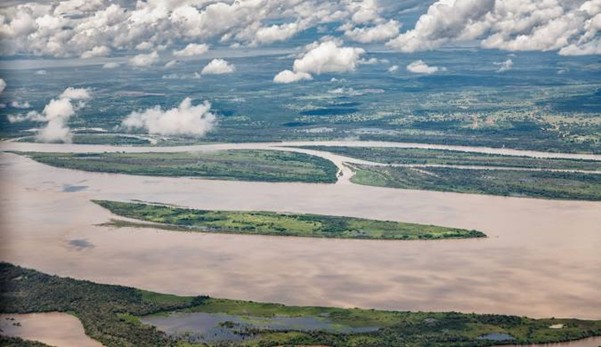
The mind-boggling beauty known as the Orinoco River formed in a part of the world already renowned for its abundance of natural beauty. That location does not surprise many people, however, as this marvel resides on the continent of South America. Its location places it in the immediate northern portion of the continent. Much of its length lies within the boundaries of Venezuela, with the remainder of its expanse falling inside the national confines of the sovereign state of Colombia.
Its course forms a wide, arcing ellipsoid shape. This surrounds the large structure known as the Guiana Shield, a tectonic plate formation.
The impressive Orinoco River immediately intrigues those individuals fortunate enough to view this marvel of nature. The river does so not only for its sheer beauty, but also for its fabulous formation, which garners much appreciation due to its other fascinating attributes.
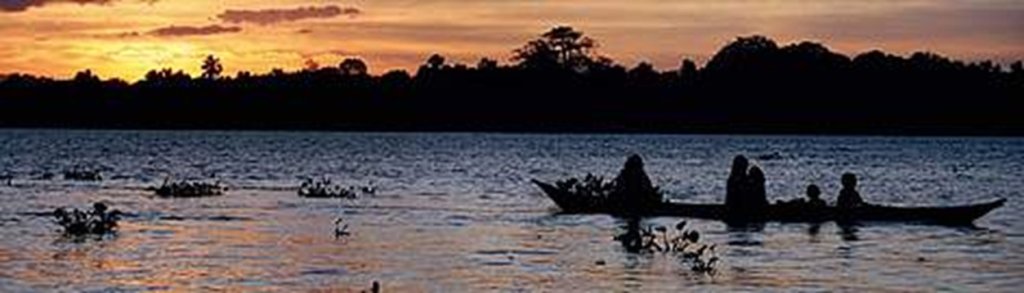
The Orinoco River, flowing through Venezuela and Colombia, is one of South America’s most significant and breathtaking waterways. This majestic river stretches about 2,140 km (1,330 miles), shaping varied landscapes and sustaining rich ecosystems.
This astounding creation of natural forces begins at the southern end of the Parima Mountains in Venezuela. Its headwaters originate near Mount Delgado Chalbaud. From its humble beginnings, it flows west, northwest, departing the mountains from which it sprang. The river grows large as it gains water from many mountain tributaries. Many of these themselves form the prodigious rainfall prevalent in the region, although a few arise from natural springs.
The beautiful Orinoco River plays a pivotal role in the ecology of the region. Its waters serve as home to an abundance of wildlife. Mammals such as river dolphins and the giant otter thrive in its depths. One of the rarest reptiles on earth, the Orinoco crocodile, does too. Understandably, a huge number of fish species also flourish within its confines.
The Orinoco hosts the Western Hemisphere’s richest carnivore diversity and endangered species like the Orinoco crocodile.
Its vast flora, fauna, and open remote areas make it one of the best wildlife-watching spots. For nature and adventure lovers, this region definitely can take you to the next level.
BIRDING IN THE LLANOS
The Llanos are a birder’s dream. The region has no fully endemic species, but the White-bearded Flycatcher and Pale-headed Jacamar are semi-endemics found only in Colombia and Venezuela. The Orinoco region hosts over 1,000 bird species, including scarlet ibis, bellbirds, umbrella birds, flamingos, and colorful parrots. Moreover, there are at least 70 different aquatic bird species found in the region, including the rare Orinoco Goose, Jabiru Stork, as just mentioned, the magnificent Scarlet Ibis, and bizarre-looking Horned Screamer.
Classic tropical species like macaws, toucans, and tanagers also abound in the forests of the plains. In the dry season, roughly between November and April, thousands of herons, ducks, ibises, flamingos, and storks flock to the few remaining watering holes, making for one of South America’s most incredible natural spectacles.
OTHER ANIMALS IN THE LLANOS
It is not just birds that make this region such a natural joy. The number of mammals, reptiles, and amphibians is also quite astounding. Devotees of nature will be completely blown away by the sheer mammalian diversity. Giant anteaters stroll across the savannas, howler monkeys swing through the trees, giant capybaras move in herds of more than one hundred individuals, pink river dolphins jump with zest from the rivers, and even the mysterious jaguar gives away its presence through footprints and not much else.
Fortunate travellers can even get up close and personal with the mighty anaconda.
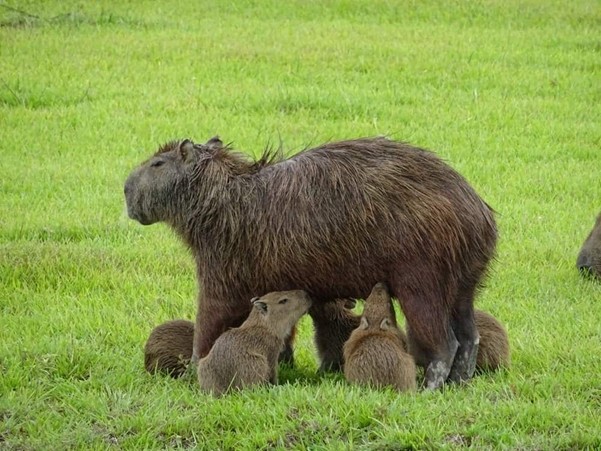 Capybaras
FLORA AND FAUNA
Many of the natural trees in the region have been reduced greatly by deforestation. Surviving in the open savanna are mainly trees that have adapted to the dry conditions, such as the chaparro (scrub oak) and the dwarf palm, as well as sedges and swamp grasses, while along the river banks, growing in rich alluvial soil, are the morichales, named for the miriti or moriche palm.
Fish are plentiful as well, including electric eels, catfish often weighing over 200 pounds (91 kilos), and the Caribbean piranha, usually considered the most aggressive of piranhas.
The Orinoco River system is also home to larger aquatic species, such as the Boto (Amazon River Dolphin), which can grow up to nine feet in length, as well as boa constrictors and caimans.
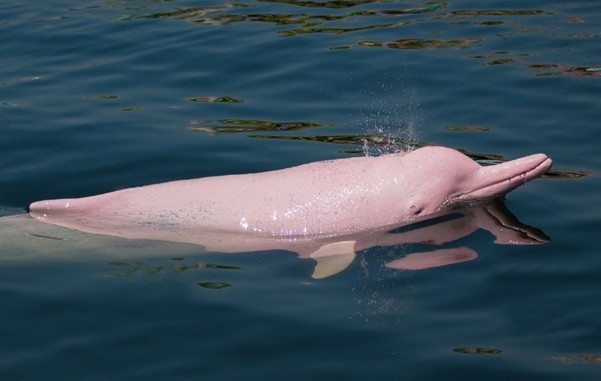 Boto – pink dolphin
Begin organizing your dream Colombian getaway right away by using our Plan My Trip page!
The Orinoco Crocodile, reaching more than 20 feet/6 metres, is one of the rarest reptiles in the world, with fewer than 250 specimens known to exist in the wild. Its present-day range is restricted to the Orinoco River Basin.
NATURAL RESOURCES
The highlands are rich in mineral deposits such as iron ore, manganese, nickel, vanadium, bauxite and chrome. There are also deposits of gold and diamonds, while petroleum and natural gas deposits are abundant in the delta area.
CASANARE
People often believe that the Amazon Jungle is the place to visit if you want to experience exuberant wildlife in Colombia. While it is an exceptional place with plenty of wildlife, travellers will be positively amazed by the abundance of wildlife in the Casanare region, where, without any particular effort, it is possible to see a variety of animals while out walking, driving or on horseback. Across the savannah, you will be able to observe a tremendous amount of birds, from different types of herons to ibis, spoonbills, jabirus, parrots and many more.
Casanare is relatively new to tourism, and it is actually considered an off-the-beaten-track destination in Colombia. Many Colombians from other parts of the country do not realise where it is and what there is to do and see there.
This is actually a fantastic opportunity to visit a completely safe area with plenty of attractions that not too many people dare to visit. Casanare has always had this incredible wildlife and authentic lifestyle. However, it is only recently that tourism has been undertaken.
PARKS AND NATURAL RESERVES
The Orinoquía has a wealth of natural attractions, including numerous nature reserves. You can find many small and private ones apart from the National Reserves, each with a focus on conservation or recovering ecosystems.
The National Natural Park of Serrania de La Macarena was created in 1971, and the protected area encompasses 622,000 hectares (1,537,000 acres). It is situated within the Serranía de la Macarena mountain range, whose highest peak reaches 8,759 feet (2,670 metres), the highest point in the Orinoquía Region. It has a tropical climate, with a temperature range of 6°C – 31°C (43°F – 88°F), conditions which enable it to maintain its many endemic and rare species.
This national natural park is still not that well known outside of Colombia, and its remoteness means few people venture into it. Despite this, the Macarena National and Ecological Reserve Park remains one of nature’s strongholds. The incomparable Caño Cristales River is celebrated as The River of Five Colours or Colombia’s Liquid Rainbow and is considered one of the most beautiful rivers in the world due to its striking array of colourful blooming algae.
Here, the riverbed and boulders are covered with Macarenia clavigera moss and algae, which for much of the year appear dull green and brown water plants.
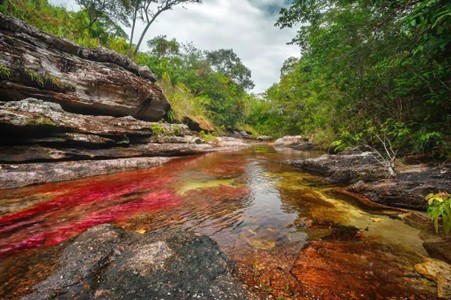 Caño Cristales River
The water level regulates the amount of sunlight reaching the plants, so there is a short period between the dry and rainy seasons where the sunlight and water’s translucence are just right. The mosses bloom in deep reds and glowing pinks and are offset by patches of yellow-green sand and blue water. There are also a host of awe-inspiring waterfalls in the area, as well as amazing hikes and geological sites to explore.
The best time to visit is late July through early December, and especially in August to appreciate the variety of colours. Though remote, the spectacle does attract international adventurers setting off from the town of La Macarena.
EL TUPARRO NATIONAL NATURAL PARK
Located in the Orinoquía Region of Colombia, the park is home to Raudal de Maypures, a famous river with amazing rapids. The park, which was created in 1970, comprises two ecosystems – flooded savannahs and non-flooded savannahs.
Three-quarters of the park is covered by savannahs, with the rest being covered by gallery forests. The Moriche Palm and Caraipa Ilanorum trees are the predominant plants, with grass being dominant in the non-flooded savannahs.
It has an average annual rainfall of 2,477mm/98 inches to the west and 2,939mm/116 inches of rainfall in the east, with a 27°C/81°F average temperature and it is rich in fauna and flora, hosting 74 mammal species, 17 reptile species, 320 bird species, five primate species and 26 fish species.
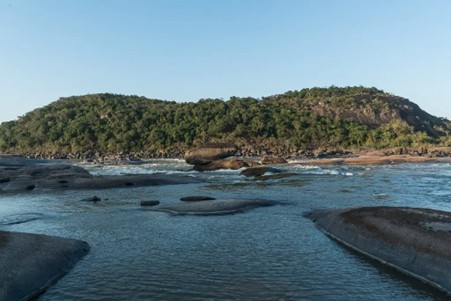 Tuparro Natural Park
Examples of birds found in the park are guans, screamers and eagles. As for mammals on the savannah, you can spot the white-tailed deer and the small Savannah Armadillo. In the woodlands, there are pumas and jaguars.
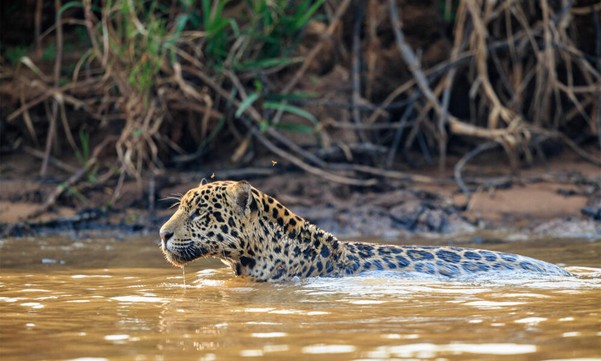
THE BOJONAWI NATURE RESERVE
The reserve is located in the municipality of Puerto Carreño in the department of Vichada in eastern Colombia and it hosts a large diversity of wildlife within its expanses that cover much of the great Orinoco River. The total space of the reserve covers roughly 11,569 acres/4,682 hectares, which includes forests, lakes and rivers. “Bojonawi“, in the indigenous language Sikuani, means otter, which is one of the many creatures living within its depths.
The Bojonawi reserve is located within the larger Biosphere Reserve of Tuparro, which was established in 1982 for its potential for conservation, studies, sustainable development and bi-national coordination with Venezuela. However, many of the rare animals found along the Orinoco River and within the Bojonawi reserve are in danger of becoming extinct, including the namesake giant otter, river dolphin, manatee, jaguar, giant armadillo, anteater and giant tortoise.
Like to create or customize a fantastico package tour of Colombia? Use our Plan My Trip page to start planning your dream Colombian vacation now .